



Description
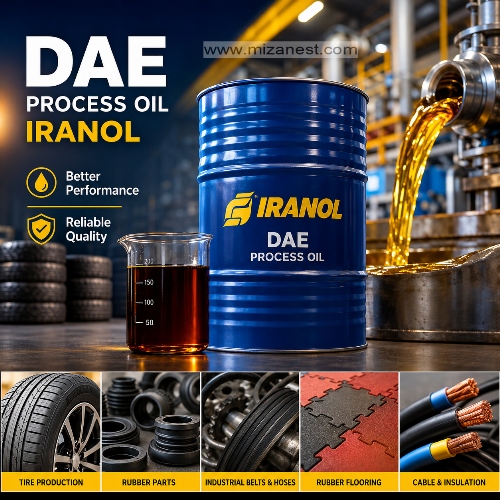
Iranol DAE Process Oil
A key material for the rubber, tire, and polymer parts industry
In rubber and polymer industries, selecting the right process oil is not a secondary detail; it directly affects flexibility, processability, durability, final cost, and even the appearance of the product. For this reason, DAE group process oils still hold an important position in many industrial formulations, especially in tire production and heavy rubber components. Because, naturally, humanity decided to mix thousands of kilograms of rubber at a molecular level just to make something that gets stuck in traffic.
What is DAE?
DAE stands for Distillate Aromatic Extract. This process oil is obtained from refining petroleum fractions and contains a significant proportion of aromatic compounds. This aromatic structure provides excellent compatibility with both synthetic and natural rubbers.
DAE oils are typically used in the following industries:
✔ Automotive tire production (passenger and heavy-duty vehicles)
✔ Industrial rubber components
✔ Industrial hoses and belts
✔ Rubber flooring products
✔ Polymer compounds
✔ Cable and insulation industries
✔ Engineering rubber products
Features of Iranol DAE Process Oil
Iranol Petroleum Company is one of the well-known producers of industrial and process oils in Iran, and its DAE oil is widely used in rubber and tire manufacturing plants.
Key features:
✔ High compatibility with various elastomers
✔ Improved mixing process in compounding
✔ Increased flexibility of final product
✔ Reduced hardness of rubber compounds
✔ Proper dispersion of carbon black and fillers
✔ Stable performance during production
✔ Reduction in formulation cost
Role of DAE in Tire Industry
In tire manufacturing, process oil is not just a lubricant. It directly influences:
✔ Tire softness
✔ Crack resistance
✔ Extrusion process behavior
✔ Carbon black dispersion
✔ Compound viscosity control
✔ Final product durability
In practice, changing one grade of process oil can significantly alter the entire production line behavior. Rubber industry is a strange mix of advanced chemistry and constant battle with viscosity.
General Specifications of DAE
Exact values depend on the grade, but DAE oils typically have:
✔ Suitable viscosity for blending
✔ High aromatic content
✔ Dark color
✔ Appropriate flash point
✔ Controlled volatility
✔ Good thermal stability
Difference Between DAE and Other Process Oils
Other process oils include TDAE, RAE, and MES. The main differences lie in aromatic content and environmental requirements.
DAE
✔ High compatibility with rubber
✔ Strong performance in industrial formulations
✔ More cost competitive in many markets
TDAE
✔ Lower aromatic content
✔ More environmentally compliant (European standards)
✔ Widely used in modern export tires
MES
✔ Lower aromatic content
✔ Suitable for specific applications
Selection depends on product type, target market, regulatory requirements, and formulation design.
Packaging and Supply
Iranol DAE process oil is usually supplied in:
✔ Steel drums
✔ Tanker shipments
✔ Bulk industrial delivery
It is available for large-scale rubber and polymer industries.
Iran’s Export Market for DAE Oil
Iran is considered an important supplier of process oils in the region due to access to petroleum feedstock. Iranian DAE oil is used in various Asian, African, and neighboring markets.
Main advantages:
✔ Stable access to petroleum feedstock
✔ Strong production capacity
✔ Competitive pricing
✔ Bulk supply capability
✔ Access to export ports
Technical Data Table (Iranol DAE)
| Physical & Chemical Properties | DAE 10 | DAE 40 | DAE.S30 | Test Method |
|---|---|---|---|---|
| Kinematic Viscosity @100°C (cSt) | 10 | 30–60 | 20–30 | ASTM D-445 |
| Flash Point (°C) | 215 | 265–300 | ≥200 | ASTM D-92 |
| Pour Point (°C) | +9 | 15–20 | +15 | ASTM D-97 |
| Density @15°C (kg/m³) | 1000 | 995–1020 | 1000 | ASTM D-1298 |
| Aniline Point (°C) | 35 | 50–65 | 25 | IP-2 |
Technical Interpretation of Data Sheet
Kinematic Viscosity @100°C (ASTM D-445)
This parameter defines how thick or fluid the oil is at high temperature.
✔ DAE 10: ~10 cSt (lighter grade)
✔ DAE.S30: medium viscosity
✔ DAE 40: higher viscosity (heavier grade)
Implications:
✔ Higher viscosity = stronger mechanical stability
✔ Lower viscosity = easier mixing and flow
Flash Point (ASTM D-92)
Defines the temperature at which oil vapors can ignite.
✔ Higher flash point = safer handling and storage
✔ Lower evaporation during processing
✔ Better thermal stability in mixers
DAE 40 shows the highest thermal resistance, making it more suitable for high-temperature processing such as Banbury mixers.
Pour Point (ASTM D-97)
Indicates flowability at low temperature.
✔ Important for storage and pumping
✔ These grades are designed for normal industrial climates, not extreme cold environments
Density (ASTM D-1298)
Provides insight into molecular structure and aromatic content.
✔ ~1000 kg/m³ indicates significant aromatic composition
✔ Better compatibility with elastomers
✔ Stronger plasticizing effect in rubber compounds
Aniline Point (IP-2)
One of the most critical parameters in process oils.
✔ Lower aniline point = higher aromatic content
✔ Higher aromatic content = better rubber compatibility
Interpretation:
✔ DAE.S30 → 25°C (high aromatic, strong softening effect)
✔ DAE 10 → 35°C (balanced)
✔ DAE 40 → 50–65°C (lower aromatic content)
Impacts:
✔ Carbon black absorption
✔ Filler dispersion
✔ Compound flexibility
✔ Dynamic rubber behavior
Practical Selection Logic
✔ Softer compounds → DAE 10 or DAE.S30
✔ Higher mechanical strength → DAE 40
✔ Faster mixing → lighter grades
✔ Heavy tires and industrial parts → DAE 40
Test Standards Used
✔ ASTM D-445 → Viscosity measurement
✔ ASTM D-92 → Flash point (Cleveland Open Cup)
✔ ASTM D-97 → Pour point
✔ ASTM D-1298 → Density
✔ IP-2 → Aniline point
These standards ensure data comparability across suppliers.
Conclusion
DAE process oil remains a fundamental material in the rubber and tire industry. It improves processing behavior, controls mechanical properties, and reduces production costs.
Iranol’s process oils are widely used due to availability, industrial supply capability, and export readiness.
Correct selection of DAE grade directly impacts final product quality, production efficiency, energy consumption, and waste levels. In real industrial production, process oil is not a simple additive; it is part of compound engineering itself.
And yes, the entire multi-billion-dollar rubber industry sometimes depends on controlling a few degrees of temperature and a few viscosity units. That’s manufacturing reality, not poetry.


Reviews
There are no reviews yet.