



Description
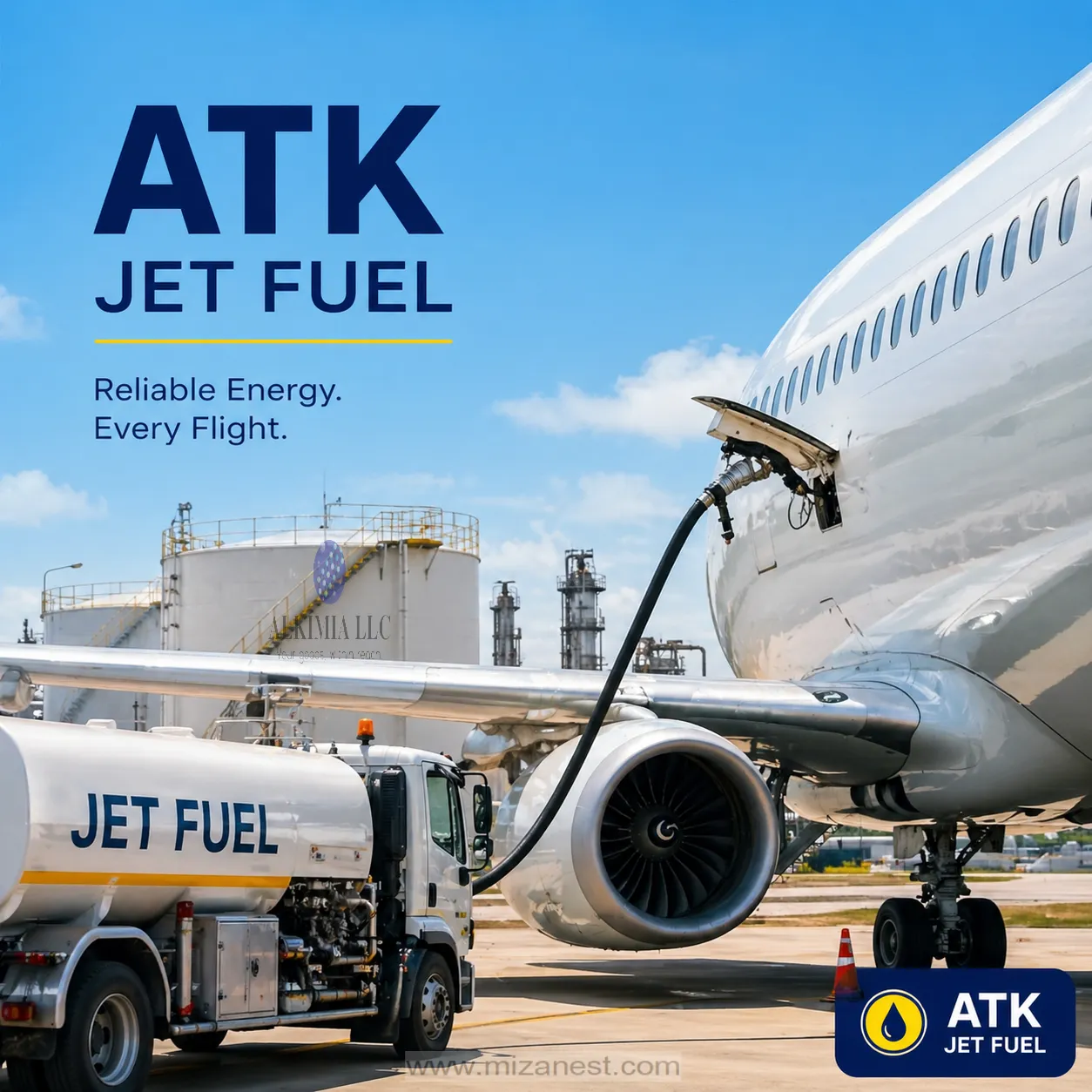
Jet Fuel ATK — Produced by the National Iranian Oil Products Distribution Company | Technical Specifications, Quality Analysis and Export Advantage
The Jet Fuel ATK presented on this page is produced and distributed through the official refining structure of Iran’s petroleum industry:
the National Iranian Oil Products Distribution Company.
Introduction to the Producer — The Core Pillar of Trust in the Aviation Fuel Market
The National Iranian Oil Products Distribution Company (NIOPDC) is the primary governmental arm of Iran responsible for:
✅ Crude oil refining
✅ Production of standardized petroleum products
✅ Strategic energy storage
✅ Domestic distribution and export of petroleum products
This organization operates an extensive infrastructure including major refineries, storage terminals, transmission pipelines, and a nationwide distribution network. It serves as the official fuel supplier for:
✅ International airports
✅ Domestic and international airlines
✅ Military and logistical operations
✅ Regional and global export markets
For this reason, jet fuel produced within this structure is not an intermediary commodity, but a real operational aviation fuel used in active aviation systems.
🔷 Jet Fuel Analysis Table (Jet Fuel – ATK)
Part One: Physical Properties and Distillation
| Analysis | Unit | Limit | Test Method |
|---|---|---|---|
| Visual Appearance | — | Clear, bright and free from solid matter and undissolved water at ambient temperature | Visual |
| Color | — | Report | ASTM D156 or D6045 |
| Density @ 15°C | kg/m³ | 840 – 875 | ASTM D4052 / IP 365 |
| Distillation | — | — | ASTM D86 |
| IBP | °C | Report | ASTM D86 |
| 10% Recovered | °C | Max 205 | ASTM D86 |
| 50% Recovered | °C | Report | ASTM D86 |
| 90% Recovered | °C | Report | ASTM D86 |
| End Point | °C | Max 300 | ASTM D86 |
| Residue | % vol | Max 1.5 | ASTM D86 |
| Loss | % vol | Max 1.5 | ASTM D86 |
| Flash Point | °C | Min 38 | ASTM D56 or IP 170 |
| Kinematic Viscosity @ -20°C | mm²/s | Max 8 | ASTM D445 or IP 71 |
| Freezing Point | °C | Max -47 | — |
| Smoke Point | mm | Min 25 | — |
| Smoke Point and Naphthalene | mm | Min 25 | — |
| Naphthalene Content | v/v% | Max 3 | — |
Part Two: Chemical and Performance Properties
| Analysis | Unit | Limit | Test Method |
|---|---|---|---|
| Specific Energy | MJ/kg | Min 42.8 | — |
| Total Acidity | mg KOH/g | Max 0.015 | ASTM D3242 |
| Aromatic Hydrocarbon | v/v% | Max 25 | ASTM D1319 |
| Total Aromatic | v/v% | Max 26.5 | ASTM D6379 |
| Total Sulfur | m/m% | Max 0.30 | ASTM D2622 / D1266 / IP336 |
| Mercaptan Sulfur | m/m% | Max 0.003 | ASTM D3227 |
| Doctor Test | — | Negative | IP30 |
| Copper Strip Corrosion | Class | Max 1 | ASTM D342 / IP130 |
| Existent Gum | mg/100ml | Max 7 | IP540 |
| Particulate Contamination | mg/lit | Max 1.0 | ASTM D5452 / IP423 |
| Electrical Conductivity | pS/m | 50 – 600 | ASTM D2624 |
| Lubricity | mm | Max 0.85 | ASTM D5001 |
Part Three: Operational and Filtration Tests
| Analysis | Unit | Limit | Test Method |
|---|---|---|---|
| Lubricity – Test Temperature | °C | Min 260 | ASTM D3241 |
| Tube Rating Visual | — | Less than 3 | ASTM D3241 |
| Pressure Differential | mmHg | Max 25 | ASTM D3241 |
| MSEP without SDA | Rating | Min 85 | — |
| MSEP with SDA | Rating | Min 70 | — |
Delivery Location of Jet Fuel ATK Produced by NIOPDC
Delivery of this product is available, based on buyer selection, from the storage terminals of the National Iranian Oil Products Distribution Company located in Isfahan or Arak.
Quality Proven in Aircraft Engines — Not Only on Paper
The first striking aspect of this analysis is the tight control over critical operational parameters.
A density range of 840–875 kg/m³ reflects an optimal balance between energy content and combustion behavior. The fuel is neither excessively light—causing rapid evaporation—nor overly heavy, which could lead to incomplete combustion.
The −47°C freezing point is a vital parameter for high-altitude aviation. At cruising altitudes, ambient temperatures drop dramatically. Any fuel crystallization would pose severe operational risks. This value confirms full suitability for real flight conditions.
Combustion Performance of Jet Fuel (Jet A-1 Behavior)
A minimum Smoke Point of 25 mm indicates low soot formation tendency. This directly impacts:
✔ Engine lifespan
✔ Maintenance cost reduction
✔ Combustion efficiency
At the same time, aromatic content (maximum 25%) is maintained within a carefully optimized range. Lower values may reduce fuel stability, while higher values increase engine deposit formation. Here, operational balance is clearly achieved.
Specific Energy — The Number Airlines Value Most
With a minimum Specific Energy of 42.8 MJ/kg, the fuel delivers high usable energy per unit mass. For aviation operators, this translates into:
✔ Lower fuel consumption
✔ Extended flight range
✔ Reduced operational costs
✔ Compliance with international aviation standards
Ultimately, these factors drive purchasing decisions across the aviation fuel market.
Sulfur and Corrosion Control — The Silent Enemies Managed
Maximum total sulfur content of 0.30% and mercaptan sulfur limited to 0.003% demonstrate strong corrosion control.
Negative Doctor Test results and Copper Strip Corrosion Class 1 confirm:
✔ Minimal equipment corrosion
✔ Extended fuel system life
✔ Reduced maintenance expenses
Fuel Cleanliness — The Often Overlooked Advantage
Particulate contamination limited to 1 mg/L and low existent gum levels indicate excellent cleanliness and reduced deposit formation risk.
High MSEP ratings confirm efficient water separation performance, a critical requirement for airport handling, filtration systems, and long-term storage stability.
Applications and Target Markets
This jet fuel is suitable for a wide range of aviation and energy customers:
✔ Regional and international airlines
✔ Aviation fuel supply companies
✔ Blending refineries
✔ Airport operators
✔ Fuel storage and distribution companies
Why This Product Is Attractive for Export Markets
Three main factors drive export competitiveness:
✔ Compliance with international fuel standards
✔ Competitive pricing compared with alternative sources
✔ Stable and reliable supply availability
Most importantly, the product is backed by a governmental operational structure that significantly reduces supply risk — a decisive advantage in international energy trading.
Conclusion
This jet fuel represents a standardized, stable, and dependable aviation energy product — precisely aligned with the real operational needs of the global aviation fuel market.


Reviews
There are no reviews yet.