



Description
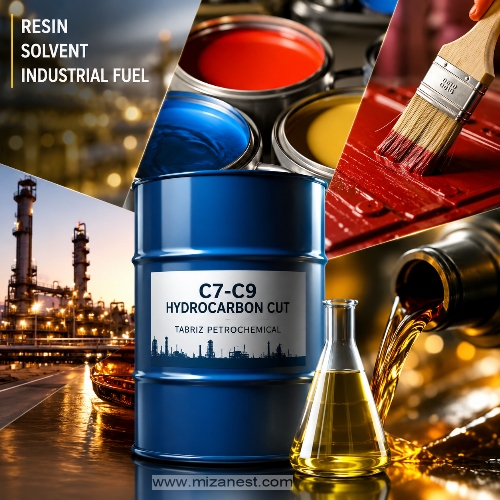
C7–C9 Hydrocarbon Cut — Specifications, Petrochemical Applications & Bulk Export Supply
When an industrial buyer searches for a stable, reliable hydrocarbon solvent suitable for multiple industries, they typically enter the product range globally known as Hydrocarbon Cut C7–C9.
This material is not merely a refinery output; it is an operational tool within modern industrial manufacturing. Plants select it not because of theoretical definitions, but because of its real performance on production lines: evaporation control, formulation compatibility, and long-term supply consistency.
What Exactly Is C7–C9 and Why Do Industries Need It?
The C7–C9 hydrocarbon cut is a mixture of hydrocarbons containing 7 to 9 carbon atoms, typically including:
✅ Paraffins
✅ Isoparaffins
✅ Naphthenes
✅ Light aromatics
This carbon range is not accidental. Process engineers rely on this specific fraction because it delivers:
✅ Controlled evaporation rate
✅ High solvency power
✅ Stable chemical blending behavior
✅ Safer transportation compared to very light solvents
In simple terms, the product sits between highly volatile gasoline fractions and slow-evaporating heavy solvents — precisely the operational window required by most industrial consumers.
Complete Technical Specifications & Laboratory Analysis
| Parameter | Value | Meaning for Industrial Buyers |
|---|---|---|
| Product Type | Hydrocarbon Cut C7–C9 | Standard refinery fraction |
| Producer | Tabriz Petrochemical Company | Continuous industrial production |
| Initial Boiling Point | 112°C | Controlled evaporation start |
| Final Boiling Point | 184°C | Defined distillation range limit |
| Loss | Nil | No operational product loss |
| Specific Gravity | 0.875 | Ideal density for transport & usage |
| Sulfur Content | 0.0066 wt% | Ultra-low sulfur level |
| Total Recovery | 99.2 vol% | High purity and uniform composition |
Practical Interpretation of Technical Specifications
What Professional Buyers Actually Evaluate
Initial Boiling Point — 112°C
This parameter confirms the product does not flash-evaporate suddenly.
✅ Suitable for paint and resin production lines
✅ Reduced safety risks
✅ Controlled coating drying behavior
For manufacturers, this means predictable formulation performance.
Final Boiling Point — 184°C
The end of the boiling range indicates compositional uniformity.
✅ No heavy residue remaining
✅ Consistent batch-to-batch quality
✅ Reduced process waste
This is a critical figure examined by thinner and resin production facilities before purchasing.
Loss = Nil
Zero loss is more than a laboratory number.
It represents:
✅ Precise refining control
✅ Standardized storage conditions
✅ Minimal evaporation during marine transportation
For importers, this parameter directly impacts shipment profitability.
Specific Gravity — 0.875
Density within this range allows the product to:
✅ Be easily transported in isotanks and drums
✅ Mix uniformly with polymers and resins
✅ Maintain stable behavior across temperature variations
Sulfur Content — 0.0066 wt%
Global chemical markets are highly sensitive to sulfur levels.
Practical advantages include:
✅ Compliance with European and Asian environmental regulations
✅ Reduced equipment corrosion
✅ Higher quality coatings and adhesive formulations
Total Recovery — 99.2%
One of the most important commercial indicators.
It means:
✅ Hydrocarbon composition remains within defined limits
✅ Long-term supply contracts become feasible
✅ Predictable performance across shipments
Real Industrial Applications of C7–C9 Hydrocarbon Cut
Paint, Coating & Resin Industry
✅ Industrial thinner production solvent
✅ Diluent for alkyd and epoxy resins
✅ Paint drying rate control
Almost every industrial paint manufacturer represents a potential consumer.
Adhesive & Rubber Industry
✅ Adhesive manufacturing solvent
✅ Rubber cement processing
✅ Formulation viscosity adjustment
The balance between evaporation rate and solvency strength explains its widespread use.
Downstream Petrochemical Industry
✅ Feedstock for hydrocarbon resin production
✅ Aromatic derivative manufacturing
✅ Intermediate chemical production
In many complexes, C7–C9 functions as a process intermediate rather than a final product.
Fuel & Energy Sector
✅ Industrial fuel additive
✅ Combustion performance improvement
✅ Component in certain gasoline blending streams
Industrial Cleaning Applications
✅ Degreasing solvent
✅ Metal parts washing
✅ Industrial cleaning fluids
Why This Product Fits Global Chemical Trade
The reality of chemical exports is that not every product achieves global acceptance. Many remain regionally consumed.
C7–C9 belongs to the category of global commodity chemicals because:
✅ Worldwide consumption standards are similar
✅ Multiple industries consume it simultaneously
✅ Marine transportation is economically efficient
✅ Continuous industrial demand exists
Therefore, the product is not country-dependent and can be supplied to most industrial markets worldwide.
Major Global Export Markets for C7–C9
Asia Market
✅ China
✅ India
✅ South Korea
✅ Vietnam
Rapid expansion of coatings, resin, and petrochemical industries drives demand.
Middle East
✅ United Arab Emirates
✅ Turkey
✅ Oman
Key regional hubs for fuel blending and re-export activities.
Europe
✅ Netherlands
✅ Belgium
✅ Italy
Strong demand for low-sulfur industrial solvents.
Africa
✅ Egypt
✅ South Africa
Growing construction and industrial coating sectors.
Latin America
✅ Brazil
✅ Mexico
Stable long-term consumers of hydrocarbon solvents.
Professional Summary for Procurement Decision-Makers
The value of C7–C9 Hydrocarbon Cut lies not in theoretical description but in dependable industrial performance.
✅ Engineered distillation range
✅ Ultra-low sulfur content
✅ Stable formulation behavior
✅ Continuous export supply capability
✅ Multi-industry usability
For manufacturers operating in paints, resins, adhesives, petrochemicals, or industrial solvents, C7–C9 represents a practical and commercially reliable raw material with global sourcing and export potential.
Reviews
There are no reviews yet.