



Description
Comprehensive Introduction to Refinery Kerosene — Technical Analysis, Applications, and Aviation Fuel Significance
Kerosene is one of the most strategically important middle-distillate fractions derived from crude oil, primarily due to its critical role as the main feedstock for aviation turbine fuels (Jet Fuel / ATF).
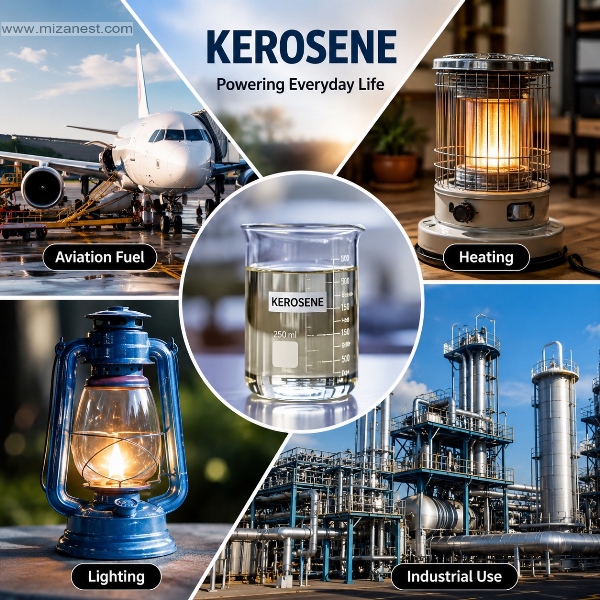
While kerosene is widely used in heating, lighting, and industrial applications, its highest-value and most technically demanding application lies in the aviation industry, where it serves as the base material for producing jet fuels such as Jet A-1.
The product discussed in this article is kerosene produced by Persian Gulf Star Oil Company, located in Bandar Abbas. This refinery is recognized as the largest gas condensate refinery In the Middle East, and the quality of its products is evaluated according to international standards.
In the following sections, a comprehensive technical analysis of specifications, applications, advantages, quality parameters, and expert insights is presented, with a particular focus on its aviation fuel potential.
Chemical Nature and Definition of Kerosene
Kerosene is a mixture of paraffinic, naphthenic hydrocarbons and a small fraction of aromatics, typically within the carbon number range of C9 to C16. This petroleum fraction distills approximately between 150°C and 275°C, positioning it between gasoline and diesel fuel.
Key characteristics include:
✅ Higher flash point compared to gasoline
✅ Lower volatility and improved storage safety
✅ Clean combustion with reduced soot formation
✅ Compatibility with a wide range of combustion systems
These properties make kerosene not only a widely used fuel, but also an ideal intermediate stream for aviation fuel production.
Technical Specifications of Persian Gulf Star Refinery Kerosene
Based on the provided datasheet:
Parameter Value
Density 783.8 kg/m³
Specific Gravity 0.7838
Flash Point 49.5 °C
Final Boiling Point 223 °C
Recovery at 185°C 65 vol%
Recovery at 200°C 93 vol%
Recovery at 210°C 97 vol%
Mercaptan Sulfur < 1 ppm
Smoke Point 28.9 mm
Loss 0.4 %
Colour 30
Expert Analysis of Quality Parameters
Density
A density of 783.8 kg/m³ falls within the optimal range for high-quality kerosene streams.
✅ Stable combustion behavior
✅ Suitable volumetric energy content
✅ Efficient atomization In burners and turbines
Flash Point
A flash point of 49.5°C indicates strong safety characteristics.
✅ Reduced fire hazard
✅ Safer transportation and storage
✅ Compliance with standard kerosene safety classifications
Smoke Point
A smoke point of 28.9 mm reflects excellent combustion quality.
✅ Low soot formation
✅ Clean burning performance
✅ Suitability for both domestic and aviation-related applications
Mercaptan Sulfur
Sulfur content below 1 ppm is a premium quality indicator.
✅ Minimal corrosion risk
✅ Lower environmental impact
✅ Reduced odor
✅ Essential for downstream aviation fuel processing
Distillation Profile
The smooth recovery curve demonstrates:
✅ Uniform fraction distribution
✅ Controlled evaporation
✅ Stable thermal performance
This is particularly important for jet fuel blending and upgrading processes.
Strategic Role of Kerosene in Jet Fuel Production
Kerosene is not merely a fuel — it is the core refinery stream used in the production of aviation turbine fuels.
In modern refineries, jet fuel production relies on:
✅ Selection of high-quality kerosene fractions
✅ Hydrotreating to remove sulfur and impurities
✅ Adjustment of freezing point and thermal stability
✅ Precise blending to meet aviation standards
The quality of the base kerosene directly determines:
✅ Jet engine performance
✅ Flight safety and reliability
✅ Compliance with international aviation specifications
Given its:
✅ Ultra-low sulfur content (<1 ppm)
✅ Balanced distillation profile
✅ suitable density for turbine combustion
✅ High smoke point
This product is an excellent feedstock for producing Jet A-1 and other aviation fuels.
Applications of Kerosene Across Industries
Aviation Industry (Primary Application)
✅ Primary feedstock for Jet Fuel (ATF)
✅ Used in Jet A-1 production
✅ Critical in aviation fuel supply chains
This is the highest-value and most strategic application of kerosene.
Energy and Fuel Applications (Secondary)
✅ Fuel for heaters
✅ Household cooking
✅ Industrial heating systems
✅ Backup generators
Chemical Industry Applications
✅ Solvent in Industrial processes
✅ Paint and resin production
✅ Chemical extraction
Agricultural Applications
✅ Spraying and pest control
✅ Equipment cleaning
Metal and Mechanical Industries
✅ Cleaning of metal parts
✅ Machining cooling
✅ Rust prevention
Emergency and Military Uses
✅ Long-term storage fuel
✅ Reliable in off-grid conditions
Advantages of Persian Gulf Star Refinery Kerosene
Based on technical evaluation:
✅ Ultra-low sulfur content
✅ Clean combustion performance
✅ High safety standards
✅ Consistent quality
✅ Strong export potential
✅ Highly suitable for aviation fuel production
Comparison with Other Fuels
Kerosene vs. Gasoline
✅ Lower volatility
✅ Safer handling
✅ Better storage characteristics
Kerosene vs. Diesel
✅ Cleaner combustion
✅ Lower soot formation
✅ More suitable for sensitive combustion systems
International Standards Related to Kerosene and Jet Fuel
Relevant standards include:
✅ ASTM D3699
✅ ASTM D1655 (Jet Fuel Standard)
✅ DEF STAN
✅ IP Standards
The product falls within acceptable international quality ranges and is well-positioned for aviation fuel processing streams.
Storage and Transportation Considerations
✅ Use standard metal tanks
✅ Prevent water contamination
✅ Avoid direct sunlight exposure
✅ Ensure proper ventilation
Safety Considerations
✅ Avoid inhalation of vapors
✅ Keep away from Ignition sources
✅ Use appropriate safety equipment
Global Kerosene Market Perspective
Market dynamics are influenced by:
✅ Crude oil prices
✅ Aviation fuel demand (primary driver)
✅ Seasonal energy demand
✅ Global energy policies
The aviation sector remains the dominant value driver in kerosene markets.
Iranian Kerosene Export Position
Iran benefits from:
✅ Abundant feedstock availability
✅ Advanced refining capacity
✅ Strategic geographic location
✅ Competitive export pricing
This creates strong positioning in regional and international jet fuel supply chains.
Expert Conclusion
Based on the provided technical specifications, kerosene produced by Persian Gulf Star Refinery qualifies as a high-quality and strategically valuable refinery stream.
Beyond conventional uses, its true economic and industrial value lies in its role as a premium feedstock for aviation turbine fuel production.
Its combination of:
✅ Ultra-low sulfur content
✅ Stable distillation characteristics
✅ Optimal density
✅ Clean combustion performance
Makes it a reliable, high-performance candidate for jet fuel blending, upgrading, and international trade.



Reviews
There are no reviews yet.