



Description
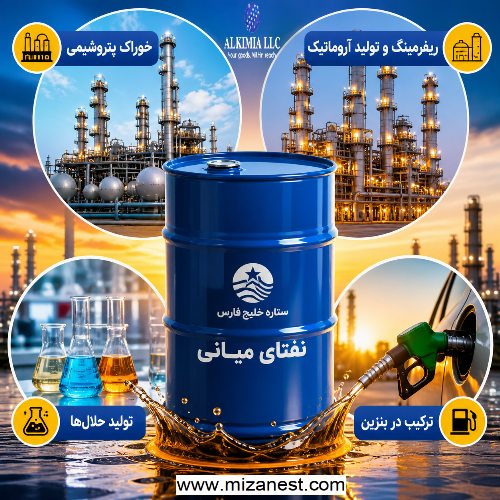
Middle Naphtha – Persian Gulf Star Refinery
Technical Analysis, Industrial Applications, and Export Opportunities
Product Overview
Middle Naphtha is a key fraction derived from crude oil and gas condensate refining, positioned within the distillation range between light naphtha and heavy naphtha. Due to its balanced composition of paraffins, naphthenes, and aromatics, it is considered a strategic feedstock for petrochemical industries, catalytic reforming, solvent production, and fuel blending applications.
The Middle Naphtha produced by Persian Gulf Star Refinery, the largest gas condensate refinery in the Middle East, offers consistent quality, controlled composition, and ultra-low impurities, making it highly competitive for international export markets.
Technical Specification
Based on the provided analysis:
Density: 749.6 kg/m³
Distillation Range: 102 – 175°C
RON: ~51
Sulfur: 0.78 ppm
Total Nitrogen: < 0.3 ppm
Vapor Pressure: 8 kPa
Paraffins: 58.89%
Naphthenes: 23%
Aromatics: 13.19%
Olefins: 1.44%
Saturates: 85.37%
Engineering Analysis of Chemical Composition
✔️ High Paraffin Content (58.89%)
This indicates an ideal feedstock for:
Steam Cracking
Olefins production (Ethylene, Propylene)
Higher paraffin content translates directly into higher olefin yields, which significantly increases petrochemical value.
✔️ Controlled Aromatics Level (13.19%)
This is a balanced range, not high enough to create environmental concerns, and not too low to reduce reforming efficiency.
Result:
Suitable for catalytic reforming units
Capable of upgrading into higher-octane gasoline components
✔️ Very Low Olefins (1.44%)
A critical parameter often underestimated.
High olefins = chemical instability
Low olefins =
Improved storage stability
Reduced gum formation
Better downstream processing performance
✔️ Ultra-Low Sulfur (0.78 ppm)
A key advantage for European and East Asian markets.
Reduced desulfurization costs
Suitable for sensitive catalytic processes
Compliant with strict environmental standards
✔️ Near-Zero Nitrogen (<0.3 ppm)
This ensures:
No catalyst poisoning
Extended equipment and catalyst life
✔️ Distillation Range (102 – 175°C)
An optimal range for:
Catalytic reforming
Aromatics production
Gasoline blending
Not too light to cause excessive volatility, and not too heavy to limit usability.
Performance in Industrial Processes
✔️ Catalytic Reforming
With moderate aromatics, high paraffins, and low sulfur, this product serves as an excellent feedstock for producing:
Benzene
Toluene
Xylenes
✔️ Steam Cracking
High paraffin content results in higher ethylene yield, which is particularly attractive for markets such as China and South Korea.
✔️ Gasoline Blending
Although RON ~51 is relatively low, it performs effectively as a blending component.
When combined with reformate, it significantly improves the final octane rating.
✔️ Solvent Production
Due to its controlled distillation range and stable composition, it is suitable for manufacturing:
Industrial solvents
Thinners
Chemical intermediates
Key Applications in Global Markets
✔️ Petrochemical Feedstock
For production of:
Olefins
Aromatics
Target markets include China, India, South Korea, and other international industrial hubs.
✔️ Refining and Reforming Units
Used to enhance naphtha value through upgrading processes.
✔️ Gasoline Production
As a blending component in fuel formulation.
✔️ Chemical Industry
Feedstock for:
Solvents
Chemical intermediates
Competitive Advantages
✔️ Consistent Quality
Unlike many smaller suppliers, this product offers reliable and stable specifications.
✔️ Gas Condensate-Based Feedstock
Compared to crude-derived products:
Cleaner
Lighter
Lower impurities
✔️ Export-Ready Specifications
Fully aligned with international market requirements.
✔️ Lower Processing Costs for Buyers
Due to:
Low sulfur
Low nitrogen
Low olefins
This directly reduces refining and treatment costs for end users.
Economic Positioning
This product is typically priced between:
Light Naphtha
Heavy Naphtha
However, its value is driven by:
High paraffin content → Petrochemical value
Low sulfur → Refining advantage
This dual-market applicability provides strong commercial flexibility.
Risks and Limitations
❌ Low Octane
Not suitable as a standalone fuel component without blending.
Technical Summary
This Middle Naphtha:
Is an ideal petrochemical feedstock
Performs efficiently in reforming processes
Maintains premium impurity standards
Adds value in gasoline blending
Its intermediate characteristics between light and heavy naphtha expand its application range, making it a versatile option for refineries and industrial users requiring both properties in a single product.
Middle Naphtha Export Supply
If you are looking for a reliable and consistent supply of Middle Naphtha for petrochemical, reforming, or blending applications, we offer direct cooperation with industrial buyers and international distributors.
✔️ Continuous supply from Persian Gulf Star Refinery
✔️ Official and verifiable analysis documentation
✔️ Suitable for Asian and European markets
✔️ Support throughout export procedures
Alkimia LLC
Supplier of Petroleum Products & Energy Carriers
📩 For full specifications, commercial terms, and allocation availability, please contact us via email or official WhatsApp channel.
Reviews
There are no reviews yet.