



Description
What Is Salt? A Complete Guide to Table Salt, Refined Salt, Rock Salt, and Core Salt
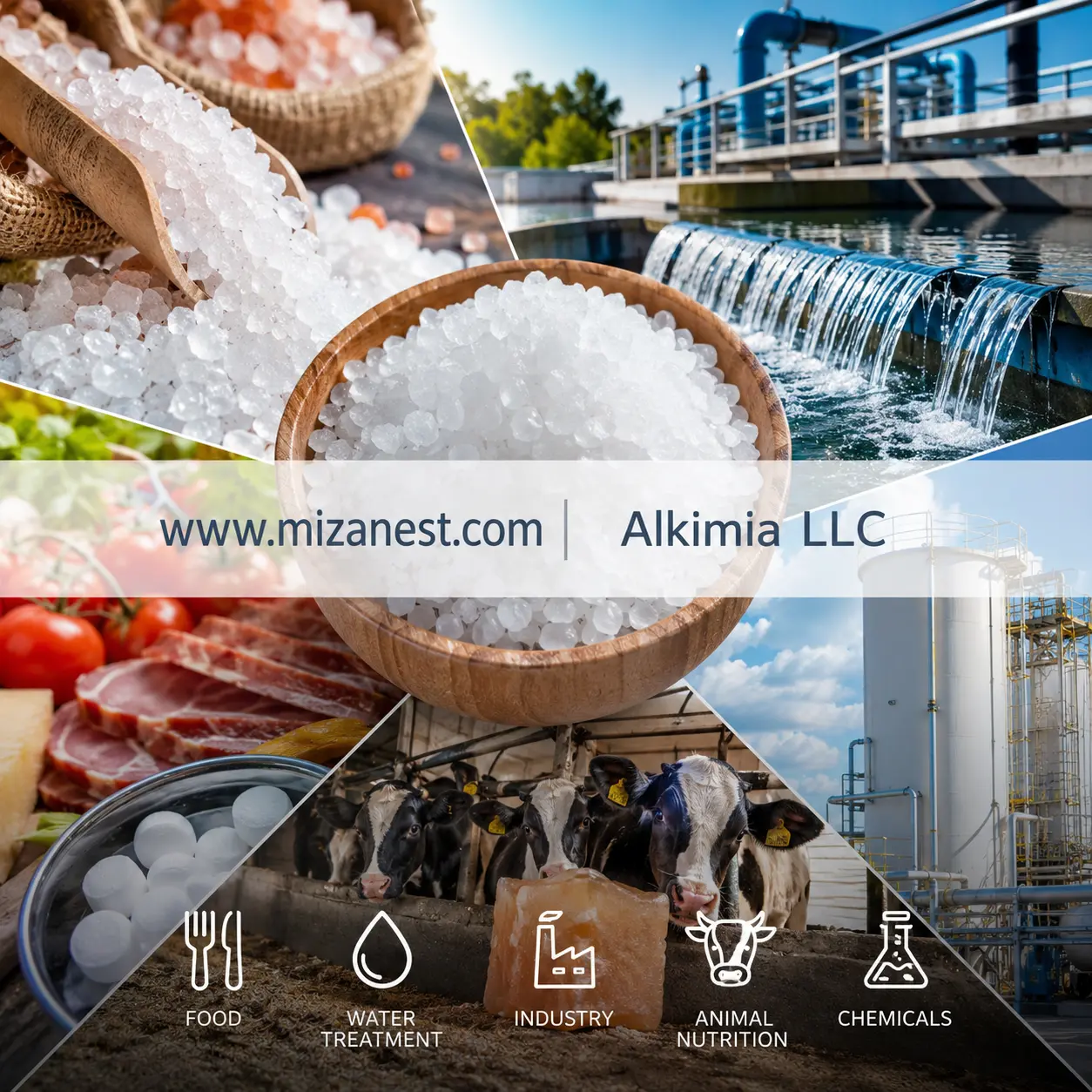
Salt is one of the oldest and most valuable minerals on Earth. For thousands of years, it has played an essential role in human civilization, serving not only as a seasoning but also as a vital raw material for numerous industries. Today, salt is widely used in the food, chemical, oil and gas, water treatment, pharmaceutical, textile, leather, livestock, and many other sectors.
Modern salt is available in several forms, including table salt, refined salt, rock salt, core salt, industrial salt, and sea salt, each offering unique characteristics and applications.
Iran is recognized as one of the leading producers and exporters of high-quality salt in the region, thanks to its abundant mineral resources and large natural salt deposits. Iranian salt is exported to many countries worldwide for both industrial and food-grade applications.
In this comprehensive guide, you will learn about the different types of salt, their production methods, key differences, applications, and important factors to consider when purchasing salt.
Major Sources of Salt
Salt is obtained from several natural sources, each offering different characteristics and advantages.
Rock Salt
A significant portion of the world’s salt production comes from underground rock salt deposits. These deposits were formed millions of years ago when ancient seas evaporated, leaving behind thick layers of crystallized salt beneath the Earth’s surface.
Rock salt is generally characterized by high purity and may naturally occur in various colors, including white, pink, blue, orange, yellow, and gray, depending on the geological composition of the deposit.
Sea Salt
Sea salt is produced through the natural evaporation of seawater in specially designed evaporation ponds. After the water evaporates, salt crystals are harvested, washed, and packaged.
In addition to sodium chloride, sea salt contains small amounts of naturally occurring minerals such as magnesium, potassium, and calcium. However, the concentration of these minerals varies considerably depending on the location where the salt is produced.
Salt from Natural Brine Springs
In some regions, underground water contains high concentrations of dissolved salt. This brine is collected in evaporation ponds, where the water evaporates naturally, leaving behind crystallized salt.
Types of Salt Based on Processing
Salt can also be classified according to the degree of processing it undergoes after extraction.
Raw Salt
Raw salt is collected directly after mining or evaporation and usually contains natural impurities such as clay, gypsum, sand, and other mineral materials.
This type of salt is mainly used in chemical manufacturing, leather processing, detergent production, oil drilling, and various industrial applications.
When intended for food consumption, raw salt must undergo refining to remove impurities and meet food safety standards.
Refined Salt
Refined salt is produced through several industrial purification stages, including washing, dissolving, filtration, recrystallization, and drying.
These processes remove most impurities, including sand, clay, gypsum, insoluble materials, and undesirable contaminants, resulting in a highly pure product.
Food-grade refined salt typically contains more than 99% sodium chloride (NaCl) and complies with national and international food safety standards.
Iodized Salt
To help prevent iodine deficiency disorders, many countries add controlled amounts of iodine to edible salt.
Iodized salt plays an important role in reducing iodine deficiency-related health conditions, particularly thyroid disorders.
It is primarily intended for household and food applications rather than industrial use.
Non-Iodized Salt
Non-iodized salt contains no added iodine and is commonly used in food manufacturing, chemical processing, pharmaceutical production, livestock nutrition, and numerous industrial applications where iodine is unnecessary or undesirable.
Salt Classification by Grain Size
Besides purity, grain size is another important specification when selecting salt for different applications.
Fine Salt
Fine salt consists of very small particles and is widely used in households, restaurants, and food manufacturing.
Fishery Salt
This medium-grain salt is commonly used in fisheries, seafood preservation, and aquaculture processing.
Granulated Salt
Granulated salt has particles similar in size to granulated sugar and is frequently used in food processing plants.
Crystal Salt
Crystal salt consists of larger salt crystals and is commonly used in industrial applications, decorative products, and export markets.
Characteristics of High-Quality Salt
When purchasing salt, price should not be the only consideration. Product quality directly affects industrial performance, food safety, and overall product reliability.
High-quality salt generally offers the following characteristics:
✔ High sodium chloride purity
✔ Low moisture content
✔ Uniform particle size
✔ Free from visible physical contaminants
✔ Very low heavy metal content
✔ Standardized packaging
✔ Excellent storage stability
Rock Salt: Characteristics, Extraction Methods, and Applications
Rock salt is one of the purest natural sources of sodium chloride and is extracted from underground salt deposits formed millions of years ago. These deposits originated when ancient seas and lakes gradually evaporated, leaving behind thick layers of crystallized salt that became buried beneath sediments over geological time.
Because rock salt is a natural mineral, it may contain small quantities of calcium, magnesium, potassium, sulfate, and other trace minerals. The exact composition varies depending on the geological characteristics of the deposit.
Iran possesses some of the world’s most valuable rock salt reserves, particularly in provinces such as Semnan, Qom, Khorasan, Fars, Zanjan, and Hormozgan. A significant portion of Iranian rock salt production is exported to international markets.
Rock Salt Extraction Process
The extraction of rock salt depends on geological conditions and mining techniques, but the general process includes several key stages.
Mining
Salt layers are extracted from underground deposits using specialized mining equipment and controlled excavation methods.
Primary Crushing
Large salt blocks are transported to crushing facilities, where they are reduced to smaller pieces for easier processing.
Impurity Separation
Visible impurities such as soil, clay, and non-salt materials are removed to improve product quality.
Screening and Grading
The salt is classified according to particle size, ranging from fine powder to large crystals.
Packaging
Depending on customer requirements, the final product may be packed in:
• 1 kg bags
• 5 kg bags
• 10 kg bags
• 25 kg bags
• 50 kg bags
• Jumbo bags (1 metric ton)
• Bulk shipments
What Is Core Salt?
Core salt is considered the purest section of a rock salt deposit. It is typically extracted from the central portion of a salt layer where exposure to soil, surface contamination, and external impurities has been minimal.
Due to its location within the deposit, core salt often appears clearer, brighter, and more uniform than ordinary rock salt.
In the Iranian salt industry, core salt is frequently marketed as a premium-grade product suitable for food processing, refined salt production, export markets, and decorative applications.
However, it is important to note that “core salt” is a commercial mining term rather than an internationally recognized scientific classification. Actual quality should always be verified through laboratory analysis.
Rock Salt vs. Core Salt
Many buyers assume these are completely different products. In reality, core salt is simply a higher-quality section of the same rock salt deposit.
| Feature | Rock Salt | Core Salt |
|---|---|---|
| Extraction Area | Entire deposit | Central section |
| Impurity Level | Variable | Usually lower |
| Appearance | Diverse | More uniform |
| Transparency | Moderate | Higher |
| Price | More economical | Typically higher |
| Main Applications | Industrial, food, decorative | Food, export, premium processing |
Rock Salt vs. Refined Salt
One of the most common questions in the salt industry concerns the difference between natural rock salt and refined salt.
The answer depends largely on the intended application.
Rock salt is a naturally occurring mineral extracted directly from underground deposits. It may contain small amounts of naturally occurring impurities and trace minerals.
Refined salt, on the other hand, undergoes extensive industrial processing to achieve high purity and consistent quality.
| Feature | Rock Salt | Refined Salt |
|---|---|---|
| Processing Level | Minimal | Extensive |
| Purity | Variable | Usually above 99% NaCl |
| Uniformity | Lower | Very high |
| Food Industry Use | Requires qualification | Fully suitable |
| Chemical Industry Use | Suitable | Suitable |
| Export Potential | High | High |
Different Colors of Rock Salt
One of the most attractive features of natural rock salt is its wide variety of colors. These colors result from trace minerals, geological conditions, and crystal structure characteristics.
White Rock Salt
White rock salt is the most common variety and is often associated with high sodium chloride content.
Its clean appearance makes it popular in both industrial and food-related applications.
Pink Rock Salt
Pink coloration is generally caused by small amounts of iron oxide within the salt deposit.
Pink salt has gained significant popularity in international markets due to its attractive appearance.
Blue Rock Salt
Blue rock salt is among the rarest natural salts in the world.
Its distinctive blue color is primarily caused by structural irregularities within the crystal lattice rather than the presence of a specific mineral pigment.
Iran is internationally recognized for producing some of the world’s most famous blue rock salt varieties.
Red and Orange Rock Salt
These colors are typically associated with iron-containing minerals trapped within the salt formation.
Yellow Rock Salt
Yellow shades may result from specific mineral inclusions and geological sediment deposits.
Gray Rock Salt
Gray rock salt often contains higher levels of natural mineral impurities compared to white salt.
Does Salt Color Indicate Quality?
Not necessarily.
Color alone should never be used as a measure of purity or quality.
For example:
• A white salt sample may have lower purity than a pink salt sample.
• A colored salt may contain fewer impurities than a visually cleaner sample.
The only reliable way to determine quality is through laboratory testing and chemical analysis.
How Refined Salt Is Produced
Refined salt production involves much more than simple washing.
Modern refining facilities use advanced purification processes to ensure high purity and compliance with food safety standards.
The main production stages include:
✔ Crushing raw rock salt
✔ Dissolving salt to produce brine
✔ Filtration and removal of insoluble impurities
✔ Removal of unwanted calcium and magnesium ions
✔ Recrystallization of sodium chloride
✔ Drying the crystals
✔ Screening and grading
✔ Iodization (if required)
✔ Hygienic packaging
This process produces a uniform product with consistent purity, color, and particle size.
Why Salt Purity Matters
Salt purity is critically important in many industries.
Even small amounts of contaminants can affect production efficiency, equipment performance, and final product quality.
Professional buyers typically evaluate the following parameters:
✔ Sodium Chloride (NaCl) Content
✔ Moisture Content
✔ Water-Insoluble Matter
✔ Calcium Content
✔ Magnesium Content
✔ Sulfate Content
✔ Heavy Metals
✔ Particle Size Distribution
Because of these requirements, reputable suppliers usually provide a Certificate of Analysis (COA) for every shipment.
Quality Control and Laboratory Testing
Reliable salt producers routinely perform laboratory testing to verify product specifications.
A standard salt analysis may include:
• Sodium chloride percentage
• Moisture level
• Insoluble matter
• Calcium concentration
• Magnesium concentration
• Sulfate content
• Heavy metal testing
• Particle size distribution
• Microbiological testing (for food-grade products)
These analyses help ensure compliance with customer specifications and international standards.
Industrial Applications of Salt
Although salt is widely recognized as a common food ingredient, it is also one of the world’s most important industrial raw materials. Hundreds of millions of metric tons of salt are produced every year, with a significant portion consumed by industries such as chemicals, oil and gas, water treatment, pharmaceuticals, agriculture, textiles, and food processing.
The quality, purity, and particle size of salt directly influence manufacturing efficiency, product quality, and production costs.
Salt in the Food Industry
The food industry is the largest consumer of edible salt worldwide.
Beyond enhancing flavor, salt performs several essential technological functions, including preserving food, controlling microbial growth, improving texture, and extending shelf life.
Major food applications include:
✔ Bread and bakery products
✔ Cheese production
✔ Butter manufacturing
✔ Meat processing
✔ Sausages and processed meats
✔ Canned foods
✔ Pickled vegetables
✔ Seafood processing
✔ Dairy products
For these applications, high-purity refined food-grade salt is generally required to meet strict quality and food safety standards.
Salt in the Chemical Industry
The chemical industry represents the largest industrial consumer of salt worldwide.
Sodium chloride serves as the primary raw material for manufacturing numerous essential chemicals used in everyday products.
Some of the most important chemicals produced from salt include:
✔ Chlorine (Cl₂)
✔ Caustic Soda (Sodium Hydroxide)
✔ Hydrochloric Acid
✔ Sodium Hypochlorite
✔ Sodium Carbonate (Soda Ash)
✔ Sodium Bicarbonate
✔ Polyvinyl Chloride (PVC)
Without salt, the production of plastics, detergents, disinfectants, paper, textiles, and many industrial chemicals would not be possible.
Salt in the Oil and Gas Industry
Salt is widely used throughout the oil, gas, and petrochemical sectors.
Typical applications include:
✔ Drilling fluid preparation
✔ Wellbore stabilization
✔ Completion operations
✔ Certain refining processes
✔ Petrochemical manufacturing
Depending on the process requirements, different grades and particle sizes of industrial salt may be used.
Salt in Water Treatment
Salt plays a critical role in water softening systems.
In ion-exchange softeners, brine solutions regenerate the resin, restoring its ability to remove hardness minerals such as calcium and magnesium.
Salt for water treatment is commonly supplied as:
✔ Salt tablets
✔ Salt crystals
✔ Granulated salt
Salt in Livestock and Animal Feed
Salt is an essential nutrient in animal nutrition.
It helps maintain electrolyte balance, supports nerve function, regulates metabolism, and promotes healthy growth.
Livestock salt is commonly available as:
✔ Salt licks
✔ Powder
✔ Granules
Salt in Leather Processing
The leather industry uses salt to preserve raw hides immediately after slaughter.
Salt reduces bacterial activity, prevents decomposition, and extends storage time before tanning.
Salt in the Textile Industry
Salt is widely used during textile dyeing to improve dye absorption and fixation on fabric fibers.
For this reason, textile manufacturers represent an important market for industrial salt.
Salt in the Pharmaceutical Industry
High-purity salt is used in the manufacture of:
✔ Intravenous saline solutions
✔ Medical rinsing solutions
✔ Pharmaceutical formulations
✔ Laboratory chemicals
Only pharmaceutical-grade salt that meets strict purity standards can be used for these applications.
Salt for Snow and Ice Control
In cold regions, industrial salt is commonly spread on roads to lower the freezing point of water and accelerate the melting of snow and ice.
This application helps improve road safety during winter conditions.
Salt Packaging Options
Salt can be packaged in various formats depending on its intended application and transportation requirements.
Common packaging options include:
✔ 500 g retail packs
✔ 1 kg bags
✔ 5 kg bags
✔ 10 kg bags
✔ 25 kg bags
✔ 50 kg bags
✔ Jumbo bags (1 MT)
✔ Bulk shipments
For export markets, moisture-resistant and durable packaging is essential to maintain product quality during transportation and storage.
Iran’s Salt Export Potential
Iran is one of the leading salt-producing countries in the Middle East due to its abundant natural reserves, competitive pricing, and high-quality deposits.
The country offers several advantages for international buyers:
✔ Large proven salt reserves
✔ High sodium chloride purity
✔ Wide range of particle sizes
✔ Food-grade and industrial-grade production
✔ Competitive export prices
✔ Access to major southern ports
Iranian salt is exported to numerous countries across the Middle East, Central Asia, the Persian Gulf region, Africa, and selected European and Asian markets.
Factors to Consider When Buying Salt
Selecting the appropriate salt requires more than simply comparing prices.
Professional buyers generally evaluate the following factors:
✔ Sodium chloride purity
✔ Product type (refined, rock salt, core salt, industrial, or food-grade)
✔ Particle size distribution
✔ Moisture content
✔ Water-insoluble matter
✔ Packaging specifications
✔ Production standards
✔ Certificate of Analysis (COA)
✔ Production capacity
✔ Delivery capability
For export transactions, compliance with destination-country regulations and customer specifications should also be verified before shipment.
Frequently Asked Questions
Is rock salt suitable for direct human consumption?
Not all rock salt is intended for direct consumption. Food-grade rock salt should be properly processed, tested, and certified to comply with applicable food safety regulations.
Is refined salt produced from rock salt?
Yes. In many refineries, high-quality rock salt serves as the primary raw material for producing refined salt through purification and recrystallization processes.
Is core salt better than ordinary rock salt?
Core salt is generally extracted from the central section of a salt deposit, where natural impurities are often lower. However, product quality should always be confirmed through laboratory analysis rather than commercial terminology alone.
Does the color of rock salt indicate its quality?
No.
Color is primarily influenced by geological conditions, trace minerals, and crystal structure. It should not be considered a reliable indicator of purity or quality.
How can salt quality be evaluated?
The most reliable method is laboratory testing, including:
✔ Sodium Chloride (NaCl)
✔ Moisture
✔ Water-Insoluble Matter
✔ Calcium
✔ Magnesium
✔ Sulfate
✔ Heavy Metals
✔ Particle Size Distribution
Conclusion
Salt is one of the world’s most essential mineral resources, supporting both daily life and countless industrial processes. Today, it is available in various forms, including table salt, refined salt, rock salt, core salt, sea salt, and industrial salt, each designed for specific applications.
Choosing the appropriate type of salt depends on the intended use, required purity, particle size, processing level, and compliance with relevant quality standards. Refined food-grade salt is generally preferred for human consumption, while rock salt, core salt, and industrial salt are widely used in chemical manufacturing, oil and gas operations, water treatment, livestock nutrition, textile production, leather processing, and many other industries.
When purchasing salt for domestic use or international trade, buyers should evaluate not only price but also laboratory analysis, production standards, packaging quality, supply capacity, and the supplier’s reliability. These factors help ensure consistent product performance, regulatory compliance, and long-term customer satisfaction.

Reviews
There are no reviews yet.