



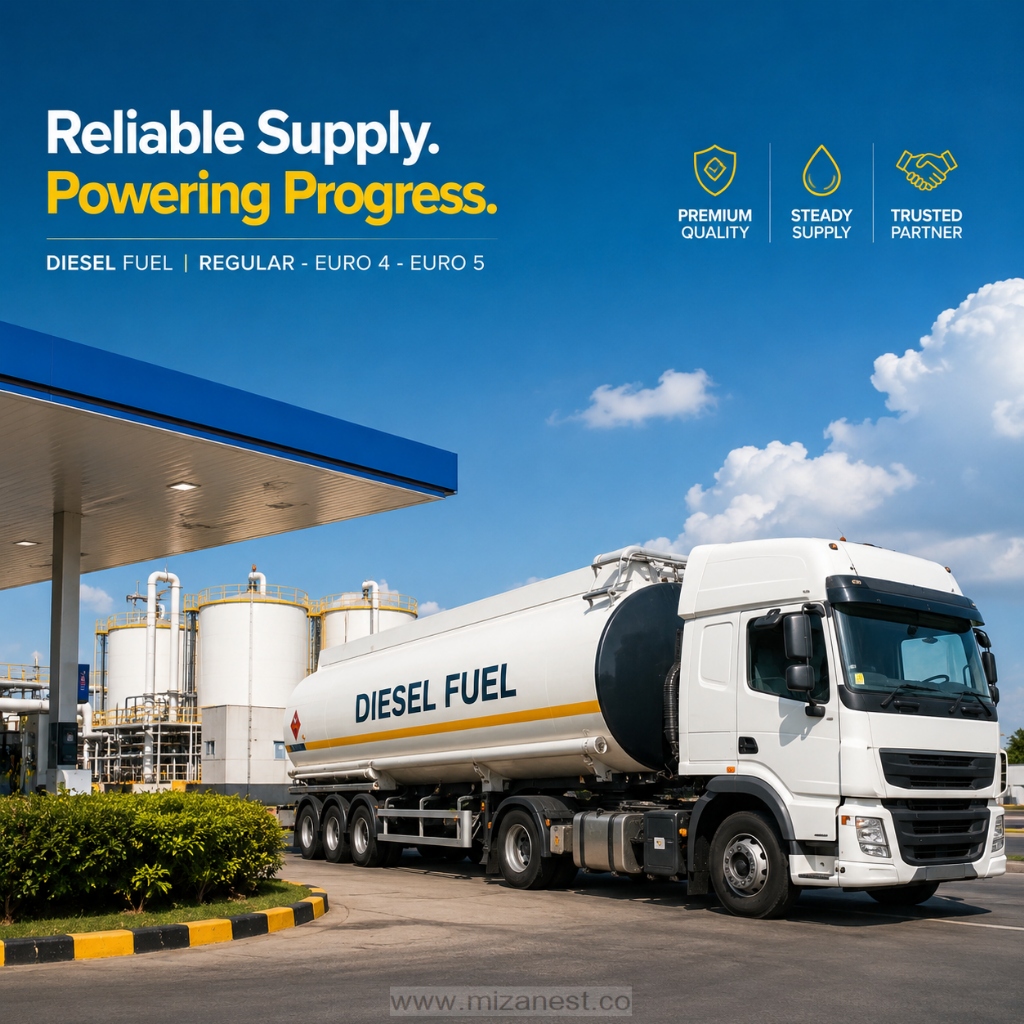
Euro 4 & Euro 5 Diesel Fuel supply for Iraq, Armenia and Afghanistan
(supply for all destination is valid but this article is for these 3 countries)
Each country has its own diesel quality rules. Armenia follows EAEU standards (as a member of the Eurasian Economic Union), meaning ultra-low-sulfur diesel (ULSD). In fact Armenia mandated European EN-590 diesel: sulphur capped at 50 mg/kg (ppm) by late 2008 and at 10 mg/kg (Euro 5 level) from January 1, 2010. Vehicles registered in Armenia must comply with Euro 4/Euro 5 emission limits (Euro 4 on trucks from 2013, Euro 5 for new cars from 2016) so diesel fuel must be very low-sulfur. Iraq has no publicly documented Euro fuel date, but its new refineries (e.g. Karbala, Erbil) are designed to produce high-quality diesel. Iraq is moving toward locally refined ultra-low-sulfur gasoil and in 2024 declared that diesel imports would be halted, implying domestic supply meets demand. Afghanistan historically used much lower-quality fuel. Almost all Afghan diesel (over 90%) has come from Iran, which uses Euro 4 (“Diesel 1”) spec (max 50 ppm S). In mid-2025 Afghanistan formally capped imported diesel sulphur at 2000 ppm (far higher than European norms) and set a minimum cetane of 51. (Plans have been floated to leapfrog directly to Euro 6 by 2025, but for now Afghan diesel is “Euro‑2/3” grade.)
✅ Export-Grade Iranian Diesel fuel(Euro IV/V): Iran’s NIOPDC (National Iranian Oil Products Distribution Co.) now produces high-grade export diesel meeting EN-590. For example, NIOPDC began Euro 4 gasoline in 2012【21†L87-L90】 and its current gasoil export grades are Euro 4 (≤50 ppm S) and Euro 5 (≤10 ppm S)
These products comply with international ULSD specs, making them acceptable in EU and regional markets. (Euro 4 fuel has ≤50 mg/kg S【22†L129-L139】; Euro 5 ≤10 mg/kg【22†L218-L227】.) The image below illustrates modern diesel tankers – Iran’s NIOPDC exports are capable of meeting such specs for large orders.
Iranian diesel export capacity – Iran is now a net exporter of gasoil, supplying Iraq, Afghanistan, Pakistan, etc..
Armenia: Market, Imports & Needs
Armenia consumes about 0.5–0.6 million tonnes of petroleum products annually. It has no oil refinery, so it imports 100% of its diesel/gasoil. In 2024 Armenia imported roughly 175,000 t of diesel and 230,000 t of gasoline (about 60% of both from Russia) – mainly via Georgian ports and railroads. The rest comes from Iran and occasional traders in Romania, Malta, Turkey. Fuel supply is distributed by the state-regulated fuel network (e.g. ArmRosGazprom) and private marketers. Armenia faces seasonal peaks in diesel demand (e.g. for heating or agriculture) and is concerned about any disruption in transit (the country depends on Georgia’s rail/road links and, increasingly, new corridors through Azerbaijan).
- Import Routes: Almost all Russian diesel arrives by tanker ship to Georgian ports (Poti, Batumi) then by rail/truck to Armenia. Iranian diesel crosses the Armenia–Iran border (Meghri crossing) or is shipped via Azerbaijan’s Nakhchivan/Georgia. A new Georgia-Ukraine-Armenia rail route now also brings some Azerbaijani fuel into Armenia (first trial in late 2025)
- Storage/Distribution: Yerevan and regional depots hold key reserves. Fuel is then piped or trucked to ~1,000 petrol stations nationwide. Government can intervene to ration or price-control during shortages.
Given its complete import reliance, Armenia’s main vulnerability is supply security. Major importers include large trading firms tied to Gazprom and SOCAR (e.g. Lukoil-Armenia, Tatneft) and state buyer ArmRos (Inter RAO group). Diversity has increased recently: Armenian officials note Iran, Turkey, and even Romania as alternative suppliers. No export or re-export of fuel currently flows out of Armenia (it’s an energy importer only), though the country is technically part of the Eurasian Customs Union, which could complicate export paperwork.
Iraq: Refining, Self-Sufficiency and Imports
Iraq’s situation changed dramatically by 2024. Fueled by new refineries (Karbala 140 kbd, Basra upgrades, etc.), Iraq claims self-sufficiency in diesel. In early 2024, the Oil Ministry announced it would halt diesel (gasoil) imports entirely. Kpler trade data confirmed zero gasoil imports in January 2024. In 2023 Iraq had still imported about 24,000 bpd of diesel (≈8.8 Mt/yr) when prices spiked. Cutting imports is expected to save Iraq ~$1 billion in 2024.
- Domestic Production: Upgraded/refurbished refineries now cover Iraq’s diesel use, so locally produced gasoil dominates. Iraq’s state marketer (SOMO) indicates the country may soon become an exporter of diesel and kerosene.
- Quality & Standards: Iraqi refineries produce Euro-4/5 quality diesel fuel for domestic consumption; the government enforces local specs to ensure reliability. There is no recent indication Iraq requires more stringent standards (since it’s exiting the import market).
- Import History: When needed, Iraq historically bought diesel from Persian Gulf suppliers. In late 2022 at a peak, diesel imports cost ~$1.4 billion, sourcing from Iran (via pipeline/tanker), Saudi/Kuwait, or even KRG (north) when its own northern pipeline had issues. But today imports are suspended, and any shortfall is met by stockpiles or emergency trucking from KRG.
In effect, demand for imports is now minimal. Iraq’s priority is to balance growth in demand with refinery output; minor seasonal purchases of diesel can occur via open tender if needed (e.g. Turkmenistan or Iran supplies during outages). Top customers/buyers (SOMO & state fuel companies) typically require Letters of Credit and strict quality certificates. Iraq’s current focus is maximizing domestic output rather than foreign purchases.
Afghanistan: Import Markets & Fuel Corridors
Afghanistan is almost entirely import-dependent for diesel, meeting ≈100% of its needs from neighbors. Its three key import hubs are Herat (West), Aqina (North), Hairatan (North).
- Volumes & Suppliers: Afghanistan uses roughly 4–5 million tonnes of diesel per year (about 4,500 thousand tonnes in recent years). Over 90% comes via Iran (through Islam Qala, Nimroz, Milak crossings). Turkmenistan supplies the north via Aqina, and Uzbekistan/Kazakhstan via Hairatan. Iraqi Kurdistan’s Oil Load Group also exports “Iraqi Diesel” to western Afghanistan through Herat
- Fuel Quality: Officially Afghanistan allowed very high-sulfur diesel; recent law now caps it at 2000 ppm. Private analyses note actual consumer diesel (e.g. “Diesel 01”) is often around 1500–2000 ppm sulfur. Diesel from Oil Load (Iraq-KRG) is refined to meet the new 2000 ppm norm (cetane ≥51). Uzbek/Russian imports (via Hairatan) comply with CIS spec (generally 500 ppm).
- Shortages & Needs: Chronic shortfalls occur in winter or when border routes are blocked. Afghan TV and analysts frequently report diesel rationing or underground markets when imports lag. Diesel is critical for power generation, transport, agriculture. The Taliban government pays Iran or Turkmenistan (often in cash or barter) for large shipments – about 3,000 MT/day move through Iranian crossings under normalized trade. Alternative suppliers (China, India) have been discussed but lack land routes.
- Supply Chains: The diagram below sketches the main pathways (Iran → Herat; Turkmenistan → Aqina; Uzbekistan → Hairatan). Afghan oil meets EAEU-standard EN-590 diesel in theory, but enforcement is weak. Private importers must clear customs at the above checkpoints with SGS certificates. Fuel sales are dominated by the state-owned Afghan Intertrade or licensed traders (following the so-called “Afghan norm” of quality checks).
“In sum: Herat fuels come from Iran and Iraq; Aqina from Turkmenistan (supplemented by Iraq); Hairatan from Central Asia” – providing a diversified base for Afghan diesel.
Supply Chain and Transit Infrastructure
Each country relies on complex logistics:
- Armenia: All diesel arrives by road or rail. From Russia: tankers bring fuel to Georgian ports (Poti, Batumi) and rail/truck to Armenia. From Iran: trucks traverse the Armenia–Iran border (south) or detour via Azerbaijan’s Nakhchivan and Georgia. There are no pipelines. Once inland, fuel goes into regional storage tanks (in Yerevan, Gyumri, etc.) then is piped to service stations. Georgia waives transit fees for trial shipments from Azerbaijan. Armenia could theoretically re-export small volumes via Batumi, but existing contracts tie diesel mainly to domestic use.
- Iraq: A network of pipelines delivers crude to refineries; then refined diesel flows by pipeline and truck to all provinces. Key refineries (Baiji, Basra, Diyala, Karbala) each have storage and distribution hubs. Diesel is also loaded onto trucks for local use or export (Iraq used to truck diesel to Syria). Now that Iraq may export, it would likely use terminal at Khor al-Zubair (Basra) or neighboring Jordan. Imports (now halted) had arrived by tanker at Al-Basrah or via pipeline from Iran (for mazut). Iraqi contracts require lab tests (GSO or SGS) at load and upon arrival.
- Afghanistan: No pipelines – everything is by road/rail. Key customs points: Islam Qala (Dogharun) and Nimroz on Iran border, Torghundi/Aqina on Turkmen border, and Hairatan on the Uzbek border. Fuel tanks at these points feed local tank farms (Herat, Mazar-i-Sharif, Kabul). From there, trucking (by Afghan drivers/trucking firms) distributes diesel nationwide. (e.g. a tanker from Aqina will go north to Kunduz or south toward Kabul.) Afghan importers must navigate local duties, and often pay bribes or fees at checkpoints. Seasonal stockpiles are kept for winter heating needs.
Overall, the regional supply chain is shaped by geography: A fuel tanker in Batumi could eventually end up in Yerevan, while a KRG-produced diesel tanker heads to Herat. Security and politics (border closures, sanctions) can disrupt these fragile links.
Opportunities & Iranian Supply (NIOPDC)
For exporters, Iran offers well-refined Euro4/5 diesel fuel with competitive pricing. NIOPDC’s official export diesel is EN-590 compliant, sourced from large refineries (Abadan, Bandar Abbas, Tabriz). It sells primarily via 2,000+ MT shipments, meeting UN GOST and CIS specifications. Buyers in Armenia, Iraq, or Afghanistan can order Iranian gasoil knowing its sulfur is ≤50 ppm (Euro 4) or 10 ppm (Euro 5). (In fact, NIOPDC reported in 2015 that Iran had become a net diesel exporter, supplying Iraq and Afghanistan.)
We can supply Iranian diesel (Euro4/Euro5) by the tanker-load. Our product comes with full analysis (EN-590 specs) and meets strict cetane and distillation criteria. Our MOQ is 2,000 metric tons per consignment. Logistics channels are ready: Iranian ports can load into trucks or tankers bound through Georgia, Iraq (via Basra), or Turkmenistan for onward delivery. Iranian Euro4/5 diesel from NIOPDC is known to meet regional norms – e.g. Afghan buyers now widely accept KRG-blended diesel at 1500-2000 ppm S, which is even higher sulfur than our Euro4 spec.
For importers: Iran’s fuel offers an alternative to Russian/Western suppliers. It comes with certificates (SGS lab, Quality Certificate) and flexible payment (Iran often accepts barter or regional currencies if needed). We recommend verifying via COA and dip tests. But historically, Iranian diesel has been sold openly to Afghanistan and others (often relabeled as “Iraq” or “Kurdistan” diesel). Modern Iran diesel is far above the old 15,000 ppm sulphur rumor – it’s genuine ULSD.
Key Points for Buyers: ✅ Iranian diesel meets EN590; ✅ NIOPDC is state-backed; ✅ 2,000 MT LOT is standard; ✅ Euro4 and Euro5 grades available. We handle export documentation and loading at Iranian terminals.
Sources and Data References
We have compiled latest available data for 2024–25 on diesel markets and regulations: official oil reports, energy analyses and trade news. All numbers (tonnage, quality limits, market share) are drawn from these sources. If certain 2025 import values are not yet published, we cite the latest statistics (e.g. 2024 volumes) as proxies. The political context (e.g. new Azerbaijani-Georgia-Armenia rail link) is based on recent press. Our product information on NIOPDC diesel is aligned with NIORDC publications and trade manuals.
Tags: diesel fuel supply, Euro 4 diesel, Euro 5 diesel, Armenia fuel imports, Iraq gasoil market, Afghanistan diesel market, NIOPDC diesel export, Middle East diesel supply, Central Asia fuel trade, import regulations diesel.
