



Description
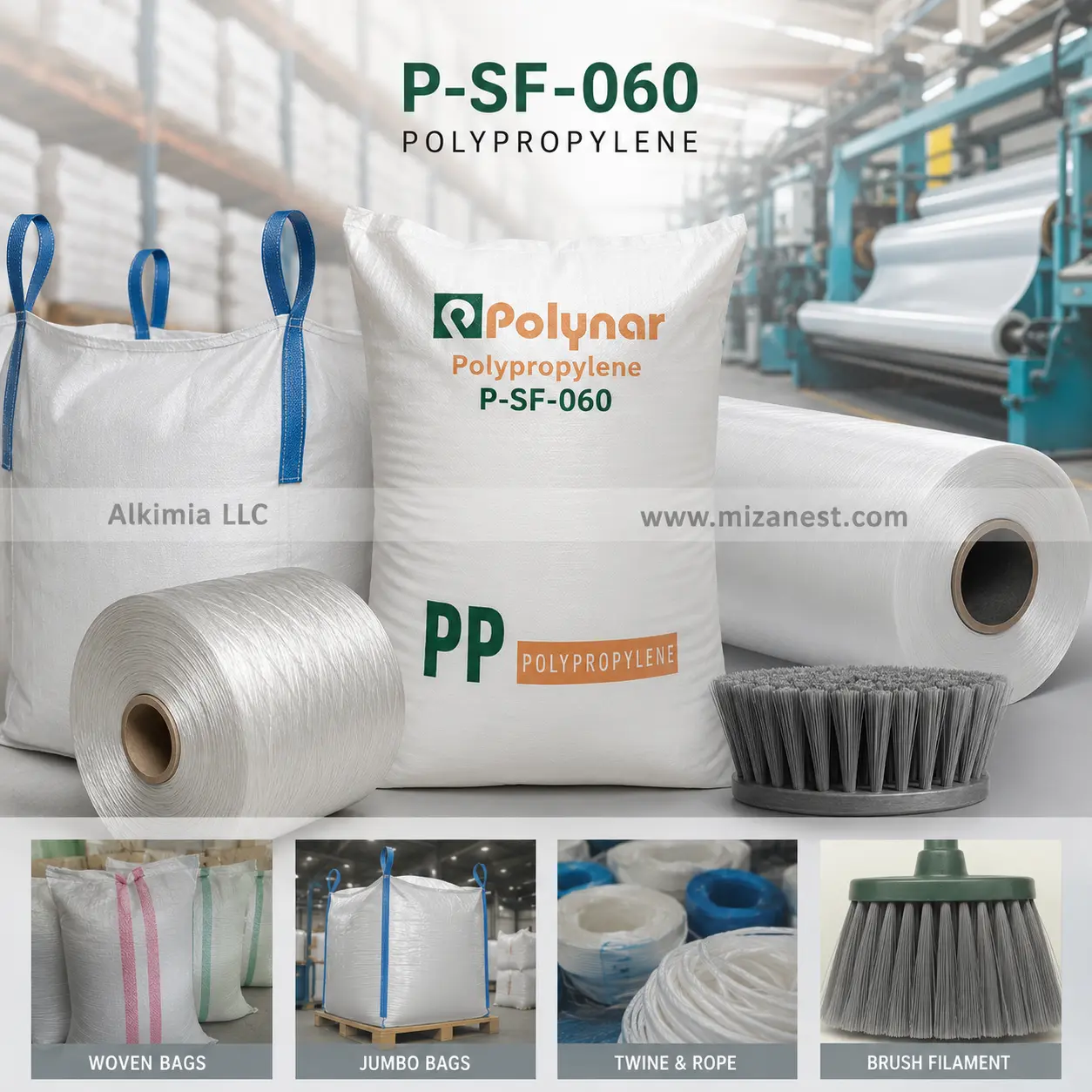
Polynar Polypropylene 060
Homopolymer
High-Performance Polypropylene for Film Yarn, Monofilament, Cast Film and Sheet Extrusion
Polynar P-SF-060 is a high-quality polypropylene homopolymer specifically engineered for extrusion applications that require excellent processing stability, high stiffness, and reliable mechanical performance. This grade has been developed primarily for the production of film yarn, monofilament, cast film, and extrusion sheet, where both productivity and finished product quality are equally important.
One of the most significant advantages of this polypropylene grade is its balanced rheological behavior. It flows smoothly during extrusion while maintaining sufficient melt strength, enabling manufacturers to produce uniform products with excellent dimensional consistency. This balance helps reduce production interruptions, minimize waste, and improve manufacturing efficiency.
Polynar P-SF-060 is also suitable for food-contact applications, making it appropriate for a wide range of packaging and industrial products requiring compliance with food safety regulations. The combination of mechanical strength, thermal stability, and excellent processability has made this material a preferred choice for manufacturers of woven polypropylene products worldwide.
Product Features
✅ Polypropylene Homopolymer
✅ Excellent extrusion processability
✅ Stable melt flow
✅ High tensile strength
✅ High rigidity
✅ Excellent dimensional stability
✅ Good impact resistance
✅ Suitable for food-contact applications
✅ Excellent surface finish
✅ Reliable performance during continuous production
Processing Methods
Polynar P-SF-060 has been specifically formulated for extrusion technologies where process stability and product consistency are essential. The material performs exceptionally well in continuous production lines and supports high-speed manufacturing.
It is recommended for the following processing methods:
✅ Film Yarn Extrusion
✅ Monofilament Extrusion
✅ Cast Film Extrusion
✅ Sheet Extrusion
During processing, the polymer demonstrates stable die pressure and uniform melt flow, reducing the likelihood of defects while increasing overall production efficiency.
Complete Technical Data Sheet
| Property | Value | Unit | Test Method |
|---|---|---|---|
| Physical Properties | |||
| Melt Flow Rate (230°C / 2.16 kg) | 6.0 | g/10 min | ASTM D1238 |
| Density | 0.90 | g/cm³ | ASTM D1505 |
| Mechanical Properties | |||
| Flexural Modulus | 1500 | MPa | ASTM D790 |
| Tensile Strength at Yield | 35 | MPa | ASTM D638 |
| Tensile Elongation at Yield | 12 | % | ASTM D638 |
| Izod Impact Strength (Notched, 23°C) | 30 | J/m | ASTM D256 |
| Thermal Properties | |||
| Vicat Softening Point (10 N) | 154 | °C | ASTM D1525 |
| Heat Deflection Temperature (0.46 MPa) | 94 | °C | ASTM D648 |
The above values represent typical laboratory properties measured according to internationally recognized ASTM standards and may be used as a guideline for material selection and product design.
Understanding the Technical Properties
Melt Flow Rate (MFR)
Value: 6.0 g/10 min
The Melt Flow Rate is one of the most important parameters when selecting a polypropylene grade. It indicates how easily the molten polymer flows under specific temperature and pressure conditions.
A value of 6 g/10 min provides an excellent compromise between melt strength and flowability. If the MFR is too low, processing becomes difficult because the material is too viscous. If it is too high, the polymer loses melt strength, making it unsuitable for stretching operations.
For film yarn and monofilament production, an MFR of 6 offers excellent processing stability while maintaining the mechanical strength required during stretching and orientation.
This characteristic allows manufacturers to achieve high production speeds with fewer process interruptions.
Density
Value: 0.90 g/cm³
Polypropylene is one of the lightest engineering thermoplastics available.
Its low density offers several important economic advantages.
✅ More finished products can be produced from each metric ton of raw material.
✅ Transportation costs are reduced because finished products weigh less.
✅ Packaging becomes more economical.
✅ Products remain lightweight without sacrificing mechanical strength.
This is one of the primary reasons polypropylene dominates the woven packaging industry.
Flexural Modulus
Value: 1500 MPa
Flexural Modulus measures the stiffness of the polymer when subjected to bending forces.
A value of 1500 MPa indicates that P-SF-060 produces rigid products capable of maintaining their shape under mechanical stress.
High stiffness is particularly valuable for woven sacks, extrusion sheets, thermoformed products, automotive components, and technical plastic parts where dimensional stability is essential.
Tensile Strength at Yield
Value: 35 MPa
Tensile Strength at Yield represents the stress the material can withstand before permanent deformation begins.
A value of 35 MPa demonstrates excellent mechanical strength for industrial applications.
This property ensures that products manufactured from P-SF-060 maintain their structural integrity during transportation, handling, stacking, and long-term service.
High tensile strength is especially important in woven bags, ropes, jumbo bags, and agricultural twines where continuous loading is expected.
Tensile Elongation at Yield
Value: 12%
This property measures how much the material stretches before yielding.
An elongation of 12% indicates a balanced combination of stiffness and ductility.
The polymer is rigid enough to retain its shape while still providing sufficient flexibility to resist cracking under normal service conditions.
Izod Impact Strength
Value: 30 J/m
Impact strength evaluates resistance against sudden shocks.
Industrial packaging frequently experiences impacts during filling, transportation, loading, unloading, and storage.
An Izod Impact Strength of 30 J/m provides dependable resistance against accidental mechanical impacts, helping improve product durability throughout its service life.
Vicat Softening Point
Value: 154°C
The Vicat Softening Point indicates the temperature at which the polymer begins to soften under a specified load.
A value of 154°C reflects very good thermal resistance for polypropylene.
Products manufactured from P-SF-060 retain their dimensional stability under elevated temperatures encountered during industrial processing and storage.
Heat Deflection Temperature (HDT)
Value: 94°C
The Heat Deflection Temperature measures the temperature at which a loaded specimen begins to deform.
An HDT of 94°C demonstrates that the material maintains its mechanical properties under moderately elevated temperatures, making it suitable for industrial products exposed to warm operating environments.
Applications
Film Yarn Production
One of the primary applications of Polynar P-SF-060 is the production of polypropylene film yarn.
Film yarn manufacturing begins with extrusion of a thin polypropylene film. This film is subsequently cooled, slit into narrow tapes, stretched under controlled conditions, and heat-set to improve tensile strength and dimensional stability.
These oriented tapes become the raw material for circular weaving machines that manufacture woven polypropylene fabrics.
Products manufactured from these fabrics include:
✅ Cement bags
✅ Rice bags
✅ Flour bags
✅ Sugar bags
✅ Fertilizer bags
✅ Animal feed bags
✅ Chemical packaging bags
✅ Industrial woven fabrics
The combination of high tensile strength and excellent processability makes P-SF-060 particularly suitable for this demanding manufacturing process.
Jumbo Bag (FIBC) Manufacturing
Flexible Intermediate Bulk Containers (FIBCs), commonly known as jumbo bags, require woven fabrics capable of carrying loads ranging from several hundred kilograms to more than one metric ton.
Polynar P-SF-060 provides the stiffness, strength, and dimensional stability required for these heavy-duty industrial containers.
Jumbo bags manufactured from this material are widely used for transporting petrochemical products, fertilizers, minerals, cement, plastic resins, grains, powders, and other bulk materials.
Monofilament Extrusion
Monofilament production differs significantly from film yarn manufacturing.
Instead of producing flat tapes, molten polypropylene is extruded through precision dies to form continuous circular filaments.
After cooling, these filaments are stretched to improve molecular orientation, resulting in higher strength, improved stiffness, and excellent abrasion resistance.
Typical applications include:
✅ Industrial brushes
✅ Household broom filaments
✅ Technical brushes
✅ Filtration products
✅ Industrial reinforcement materials
Packaging Twines and Agricultural Twines
Polynar P-SF-060 is also widely used in the manufacture of packaging twines, baler twines, industrial ropes, and agricultural binding materials.
These products require consistent tensile strength, resistance to repeated loading, and long-term durability.
The balanced mechanical properties of P-SF-060 help manufacturers produce reliable twines capable of performing under demanding industrial and agricultural conditions.
Cast Film
Cast polypropylene film is manufactured by extruding molten polymer through a flat die directly onto chilled rolls.
The rapid cooling process produces films with excellent clarity, smooth surfaces, and uniform thickness.
P-SF-060 offers excellent processing stability for cast film production while maintaining consistent mechanical properties.
Sheet Extrusion
The material is suitable for extrusion sheet applications requiring good stiffness and dimensional accuracy.
Extruded sheets manufactured from P-SF-060 are commonly converted into thermoformed packaging, stationery folders, industrial trays, protective panels, and various technical products.
Automotive Components
The combination of rigidity, dimensional stability, and thermal resistance makes this polypropylene grade suitable for numerous non-structural automotive plastic parts, interior trim components, and utility applications.
Consumer Products
The material is also used in the manufacture of durable consumer products such as plastic toys and garden furniture where lightweight construction, rigidity, and long service life are important.
Why Choose Polynar P-SF-060?
Polynar P-SF-060 combines stable processing behavior with dependable mechanical performance, making it an excellent choice for manufacturers seeking high productivity without compromising product quality.
Its balanced Melt Flow Rate, excellent stiffness, strong tensile properties, and good thermal resistance enable efficient production across a broad range of extrusion applications. Whether manufacturing woven polypropylene bags, jumbo bags, ropes, monofilaments, cast films, or extrusion sheets, this homopolymer grade provides the consistency and reliability required for modern industrial production.

Reviews
There are no reviews yet.