



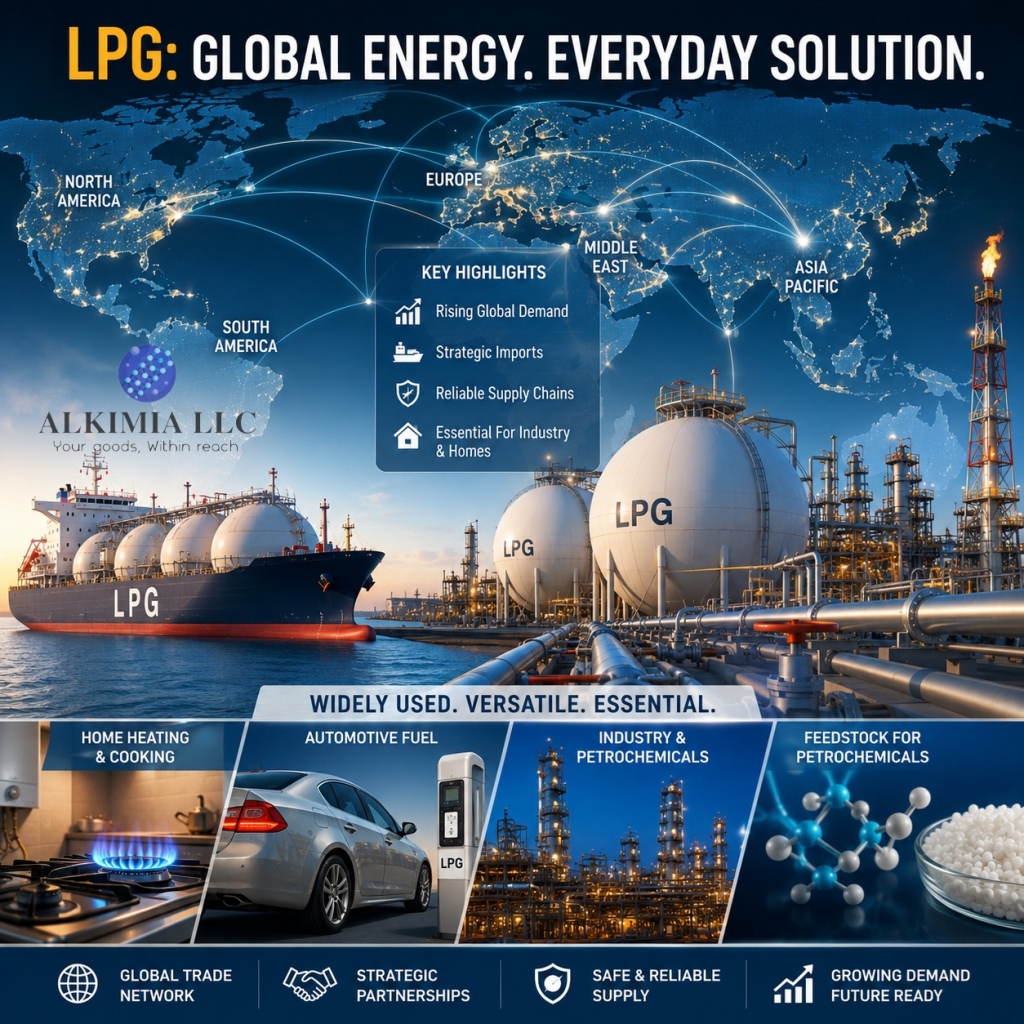
Global LPG Markets: Current Dynamics and Future Opportunities
Executive Summary
*if your eyes are not easy with this article please download PDF version*
✅ Global LPG markets continue to benefit from expanding production capacity, diversified supply chains, and growing international trade networks. New export projects in the Middle East and North America are expected to enhance market liquidity and strengthen long-term supply reliability, supporting stable commercial opportunities for importers and distributors worldwide. [3]
✅ Asia-Pacific supply shortage: The region imported ~81.8 Mt of LPG in 2022[5] while exporting only ~5.5 Mt; it normally relies on Middle Eastern and US supplies. In March 2026, ME exports to Asia plunged ~73% (to 419,000 bpd)[2], forcing buyers to divert US cargoes (US exports to Asia jumped to ~1.8 mbd in April)[6]. India and China (together >40% of global demand) led the scramble for freight and term contracts[7][1].
✅ LPG Price and demand impacts: Gulf-supply shortfalls and premium pricing caused demand destruction in end-use sectors. Asian petrochemical plants cut runs (Rystad: ~135,000 bpd LPG demand loss in crackers)[8], and even household LPG sales fell (India saw ~205,000 bpd drop in March)[9]. In Europe and the Americas, tight supply lifted local prices: but in the US high inventories (57% above average) kept domestic LPG prices (at ~37% of WTI) far below global levels[10].
✅ Mitigation strategies: To bolster security, importers are diversifying. India, for example, launched long-term US-sourced LPG contracts (2.2 MMTPA) and is exploring Norway/Algeria supplies[11][12]. Strategic stockpiles (40–45 days of demand) and underutilized storage could buffer shocks[13]. Contracts, insurance and new terminals (VLGC fleet, export capacity) are also being expanded[14][15].
✅ Outlook: In the short term, prices and freight rates will stay volatile as markets re-balance[4]. In the medium term, continued Asia demand growth (especially petrochemical use) and rising US/Mideast capacity are expected to stabilize supply. New sources (e.g. rising Iraqi exports) and infrastructure (new export fractionators) will create both opportunities (for arbitrage and fuel-switching) and continued price sensitivity[16][17].
Geopolitical Disruptions and LPG Trade Routes
The outbreak of conflict in the Gulf immediately strangled LPG exports. The Strait of Hormuz, a chokepoint for ~44 Mt/year (121,000 t/day) of LPG (~30% of seaborne trade)[1], was effectively closed. Iranian strikes on gas/NGL facilities (e.g. South Pars) further cut Gulf output. As a result, Middle Eastern LPG exports fell sharply (−73% to 419,000 bpd in March)[2]. Sans Hormuz, insurers halted coverage on regional routes, forcing ships to reroute via southern Africa or risk red-flagged waters[18][19].
The supply squeeze led Gulf producers (Saudi, UAE, Kuwait) to raise official selling prices (OSPs) by $205–260/t in April for propane/butane[3]. This in turn reverberated through global markets: Asian buyers bid up spot contracts, European and US arbitrages tightened, and shipping (VLGC) spot freight rates briefly doubled. European LPG prices jumped ~64% during the war’s onset[1] (see below). The chart below illustrates the near-term price spikes in Europe and the US:

Figure: LPG benchmark prices (Argus indices) spiking on Middle East supply disruption[1][10].
At the same time, sanctions or voluntary insurers’ rerating of Iran increased Gulf-region risk premiums. Middle East LPG producers (even those not directly involved) became cautious. The tightening forced Asian buyers to bid for any available cargo – including from the US Gulf, Mexico, and even distantly Brazil/Argentina. For example, India reportedly sought Iranian spot LPG, but rerouted orders to the US and Venezuelan/Argentinean cargoes instead.
Global Trade Volumes and Trends
Global LPG trade has grown strongly over the last decade, driven by US shale NGLs and Middle East output. In 2022 the world consumed ~342 Mt (12-year high), with production ~344 Mt[20]. From 2013–2022 consumption climbed ~3.3%/yr[20]. Key trends: U.S. NGL production surged (US output ~97 Mt in 2022, ~30% of world[21]), while Middle East Gulf production rose with higher crude quotas (KSA/UAE/Kuwait exports jumped ~16% in 2022)[22].
Regionally, Asia-Pacific is by far the largest import region: in 2022 it imported ~81.8 Mt (thousand tonnes) vs. only ~5.5 Mt exported[5]. Europe/Eurasia imported ~28.4 Mt, the Americas ~25 Mt (imports + exports roughly balancing), and Africa a few Mt (see table). The Mideast is mainly an exporter (43.0 Mt exports in 2022, up from 32.0 in 2012)[5].
Table: Global LPG Trade (2022, thousand tonnes)[5]
Region Imports | Exports
Asia-Pacific 81,772 | 5,535
Europe/Eurasia 28,417 | 19,122
North America 4,986 | 60,492
South/Central America 16,173 | 2,217
Middle East 1,564 | 43,026
Africa 7,825 | 9,400
Total 140,738 | 139,791
Major supply flows (2022): US exports (~60.5 Mt) went to all regions. US→Asia was led by Japan (12.3 Mt), China (5.4 Mt), S.Korea (5.2 Mt), Indonesia (2.6 Mt)[23]. Middle East exports to Asia were concentrated: India (19.3 Mt), China (14.6 Mt), Indonesia (3.2 Mt)[24]. Europe’s top suppliers were the US (~8.0 Mt), Norway (3.0 Mt), and Algeria/other N.African sources[25]. Canada and Australia are minor exporters (primarily to the US). In short, global LPG trade was diversified but heavily weighted Asia→Mideast/US pre-war; the conflict forced that map to redrawn overnight.
Over the last five years, global LPG trade has shown moderate growth (even through the pandemic), with Asia imports steadily increasing. For example, China and India each import ~20–25 Mt/year (now ~21.5% and ~9% of global demand[26][27]). Outward flows have grown from non-traditional sources: 2022 saw Iraq re-enter the export market (450 kt in 2022, expected ~2.5 Mt by 2025)[28], and US flows to Latin America strengthened (Mexico: 5.4 Mt)[29]. Such shifts partly soften regional supply imbalances.
Major LPG Importers and Buyers (Global and Asia)
Top importers are overwhelmingly in Asia. In 2022 China consumed ~74 Mt (21.5% of world)[26], India ~30 Mt[27], Japan ~13–14 Mt (plus re-exports to Korea), and South Korea ~10–11 Mt[30]. Other significant Asian importers include Taiwan (~3–5 Mt), Thailand (~3–4 Mt), Indonesia (~5–6 Mt[31]), and Bangladesh (~1.7–1.8 Mt[32]). Outside Asia, leading importers include Brazil (~2–3 Mt) and certain EU countries (e.g. Italy, Spain ~3–4 Mt each).
▌ Table: Key LPG Importers (approximate 2022 volumes)
Country | Imports (Mt) | Major Importers/State Companies | Main Suppliers (pre-conflict) | Key Ports/Terminals |
China | ~20 | Sinopec, PetroChina (CNPC), CNOOC | Middle East (Saudi, UAE, Qatar), USA | Qingdao, Shenzhen, Guangzhou |
India | 23–24 | Indian Oil, HPCL, BPCL (Indian NOCs) | Middle East (~90% via Hormuz[1]), USA, (now diversifying to US/Norway)[33] | JNPT Mumbai, Kandla, Mundra, Kochi |
Japan | 13 | JXTG/ENEOS, Idemitsu, Cosmo, Showa Shell | USA, Middle East, Qatar | Sodegaura, Kashima |
S. Korea | 5–6 | SK Gas, GS Caltex, Lotte Chemical | USA, (historically Oman/Gulf) | Pyeongtaek, Yeosu |
Taiwan | 3–4 | CPC Corp (state) | Qatar, UAE, Australia | Kaohsiung (CPC terminal) |
Thailand | 3–4 | PTT Group, Bangchak, Thai Oil | Middle East (Saudi), Malaysia | Map Ta Phut (PTT terminal) |
Indonesia | 5.8 | Pertamina/PGN, others | Middle East (via Saudi Aramco)[24], USA | Tuban, Plaju |
Bangladesh | 1.75 | Bashundhara Group, Jamuna Oil, Meghna Group | Qatar, UAE, Saudi (also ramping up Vietnam/Malaysia[34]) | Chattogram, Mongla (private jetties) |
Pakistan | ~0.8 | PSO (state oil), Attock Petroleum | Middle East (Iraq/Kuwait), Qatar | Karachi, Port Qasim |
Brazil | 2–3 | Petrobras, local wholesalers | US (Gulf), Algeria, Venezuela | Guarujá, Santos |
European Union (example) | – | – | US, Algeria, Russia (limited) | ARA ports (Rotterdam, etc.) |
Notes: Pre-conflict, ~48% of Asian LPG imports came from the Middle East (1.54 mbd total) and ~39% from the US[35]. India alone took ~19.3 Mt (2022) from Gulf sources[24]. After war, Asian buyers stepped up purchases from the US, increasing US→Asia flows from ~39% to over 50% of Asian imports[35]. For each country, state or private “import champions” negotiate long-term term contracts and spot cargoes to meet demand; for example, India’s IOCL/HPCL/Indane buy via government channels (PPAC), while Bangladesh’s 23 approved importers (e.g. Bashundhara, Meghna, Delta LPG) received permissions to bring in emergency supplies[32][34].
Major international LPG suppliers (exporters) include the US, Saudi Arabia, UAE, Kuwait, Qatar, and increasingly Iraq and Algeria. The US, driven by shale NGL growth, is now the single largest exporter (60.5 Mt in 2022)[5]. State-owned producers like Saudi Aramco (and ADNOC, KPC, etc.) historically supply Gulf buyers and Asia; QatarGaz drives Qatargas shipments (not fully captured post-2021 LNG/Qatar offshore reclassifications). In Europe, Algerian Sonatrach and Russian/LNG-sourced LPG are secondary sources. Key export infrastructure (fractionators and terminals) exist in US Gulf Coast (e.g. Houston, Freeport) and Gulf ports (Ras Laffan in Qatar, Fujairah terminal, etc.), and well-developed VLGC fleets move the cargo.

Figure: US LPG price (Mont Belvieu, in ¢/USG) vs WTI crude. Despite the global price rally in early 2026, US domestic LPG prices lagged due to high stocks[10].
LPG Demand by Sector and End-Use
Liquefied Petroleum Gas (LPG) versatility means it serves many sectors. The latest data show residential (household) uses dominate (~45% of global demand)[36][37]. LPG is widely used for cooking, water/heating and small power in homes (especially where pipeline gas is unavailable). In Asia, government schemes (India’s Ujjwala etc.) and rural adoption have steadily grown cylinder LPG sales. Industry (chemical plants, brick kilns, CHP) takes ~7%, transport (autogas) ~7%, refinery fuel ~13%, and petrochemical feedstock ~27%[37]. Notably, chemical-sector demand (steam crackers, PDH plants) was the fastest-growing pre-crisis, surpassing 90 Mt by 2022[38].
- Autogas (LPG vehicles): LPG is the world’s leading alternative vehicle fuel. >26 million cars run on LPG globally[39]. Autogas share is large in Italy, Poland, South Korea, Australia, and parts of Asia (Thailand taxis, some Pakistan buses), driven by lower taxes and cleaner emissions[39]. However, autogas volumes have plateaued in recent years (≈25 Mt in 2022) as some subsidies were cut[40]. Autogas vehicles burn liquid propane, requiring no major engine changes.
- Residential & Commercial Heating: LPG replaces wood/charcoal or fuel oil for cooking/heating, especially in developing economies[36]. Nearly half of LPG demand is household cooking/heating[36]. Policy drivers (subsidies, health campaigns) have expanded LPG in Asia/Africa. For example, Indonesia switched millions of families from kerosene to LPG cylinders, and India’s rural PMUY scheme enabled 331 million LPG connections[41]. In colder regions (some Eastern Europe, Russia), LPG is used for space heating where pipelines don’t reach.
- Industrial uses: LPG’s high calorific and clean flame make it useful for light industry (metal, ceramics, food processing) and as power backup. Industrial LPG demand is smaller (~7% share) but significant in some economies (e.g. Thailand industrial boilers, Brazil agro-industry). OEM burners, generators, and forklifts often run on LPG.
- Petrochemical feedstock: LPG (propane/butane) is cracked into olefins (ethylene, propylene) as an alternative to naphtha. Two main pathways exist: steam cracking of LPG in conventional crackers, and propane dehydrogenation (PDH) to propylene. LPG yields high-value plastics feedstock (ethylene/propylene). Asia has seen a boom in PDH plants: new units in China (Sinopec, Shandong) convert propane into propylene, driving up LPG demand despite weak margins[42]. Steam crackers also blend LPG. In the current crisis, many crackers curtailed runs due to feedstock shortages[43], underscoring LPG’s role in chemicals.
Typical LPG feedstock specs: >90% propane or butane with minimal inert gases. Propane dehydrogenation yields high-purity propylene; steam cracking of mixed LPG yields ~40–50% ethylene plus propylene and other byproducts (waxes, aromatics). With rising petrochemical demand for plastic resins, LPG’s use as feedstock is expected to grow.
LPG Vehicles, Home Heating and Policies
Several countries heavily use LPG in transport and homes, often driven by subsidies or fuel policies:
- Autogas: Countries like Italy (>10 million autogas cars), Poland, South Korea, and Turkey have large autogas fleets due to tax incentives[39]. Thailand promotes LPG taxis and buses to cut urban pollution. India uses LPG mainly for cooking, with limited vehicle use (some fleet conversions, but CNG dominates in transport). Where autogas is widespread, governments typically subsidize LPG tax vs gasoline/diesel. For example, an Italian LPG blend costs ~50% of petrol[44]. Autogas conversion kits are often domestic industry (e.g. Italy, Turkey supply kits to many markets[45]).
- Residential usage: Beyond subsidies, policies matter: Many Asian governments maintain cylinder LPG subsidies/tariffs to make cooking gas affordable, boosting demand[36]. “Clean cooking” initiatives encourage switching from biomass. For instance, the Indonesian government adjusted LPG pricing to favor rural uptake, and Bangladesh tightly regulates LPG imports to manage prices (Bangladesh’s cylinders saw ₹1,600–1,700 vs official ₹1,356 cap[46]). In contrast, LPG in home heating is modest in Europe (limited by availability of cheaper fuels), except in less-connected regions.
- Conversion rates: Autogas vehicle conversion rates are high where supported by incentives; e.g. South Korea and Australia had years of growth when subsidies existed[47]. However, when support is withdrawn (as in Australia after 2017), autogas sales can fall quickly[48]. Governments often manage LPG markets tightly: e.g. Brazil designates LPG as a “social fuel” (no autogas allowed)[49], whereas Hong Kong allows only LPG public buses with dedicated refueling rules[50].
Risks, Mitigation and Sourcing Strategies
LPG importers face supply, logistical and market risks, especially under conflict conditions. Key risk factors include: geopolitical chokepoints (Hormuz, Red Sea); weather (hurricanes hitting US Gulf fractionators); and market volatilities (crude and OSP swings)[17]. Insurance and financing costs rise during conflicts (war-risk premiums). On the demand side, abrupt policy shifts (fuel price changes, subsidies) can dent volumes.
Mitigation strategies adopted by companies/countries are:
- Supply diversification: Actively contracting with multiple regions. For example, India has pursued US and North African contracts to reduce 90% Gulf dependence[11][12]. ASEAN importers similarly buy from Middle East, Australia, and Russia (to some extent) to hedge. Diversification is often quantified: reports suggest aiming to cut single-region reliance (e.g. targeting <50% from any one area)[12].
- Term contracts & SPAs: Securing long-term fixed volumes (with price review formulas) lowers exposure to spot swings. Bulk buyers often sign 2–5 year agreements with majors (e.g. Aramco, Chevron Phillips, Vitol, Gunvor). Forward hedges may be arranged on LPG pricing indices.
- Storage and inventories: Building reserves is critical. Analysts propose formal LPG strategic reserves (e.g. India’s 40–45 day target[13]). Commercial storage at import terminals (USA ~50% utilization, India ~500 kt capacity[51]) can be mandated as buffer. Companies also rent or own VLGCs as floating storage in a pinch.
- Insurance and contracting: Buyers take war-risk and freight insurance, and may charter vessels with secure flags. Force-majeure clauses are invoked to allow flexibility on delivery terms.
- Logistics contingency: Planning alternate routes/terminals helps. For example, chartering VLGCs to route around Africa if Red Sea is unsafe, or using rail/tankers for inland distribution if seaports are congested.
Keywords for supplier search: Industry sources suggest importers use terms like “bulk LPG supplier”, “international LPG traders”, “propane butane exporters”, or platform-based queries (e.g. via global trade portals) to find new partners. Phrases such as ”LPG price term contract comparison” or ”LPG supply contract Asia” help them identify reliable producers and trading houses. (No authoritative survey of search terms is available, so these reflect typical industry practice.)
Market Opportunities and Forecasts
Longer-term, LPG demand is expected to grow modestly, driven by Asia’s petrochemical build-out and household energy needs. Market analysts project mid-single-digit CAGR for LPG through 2030[52]. Key opportunities:
- Petrochemical expansion: New PDH and steam-cracker projects (especially in China/India) will steadily lift LPG offtake[53][54]. Ethylene/polyethylene capacity growth in Asia often prioritizes LPG feedstock, suggesting continued feedstock demand even if mixed with naphtha.
- Clean cooking adoption: Emerging economies (India, ASEAN, Africa) likely raise LPG penetration in households, partly offsetting declines in some mature markets[55]. Cylinder distribution technology (IoT metering) can make small-volume sales viable[56], opening new rural segments.
- Switching away from dirtier fuels: Stricter emissions rules may encourage industrial fuel-switching to LPG (e.g. in brickmaking, bakeries). Also, some heavy-vehicle fleets may consider LPG/CNG transitions to meet Euro/Vehicular standards.
- US supply arbitrage: The US is set to expand fractionation/export capacity (e.g. Chevron Phillips Bluewater pipeline, Targa/Summit expansions), providing even more export volume[57]. This makes term-contract arbitrage possible for importers willing to lock long-haul supply.
Analysts also warn of risks: abundant new supply (US, upcoming Iraqi exports[28]) could push prices down once chokepoint pressures ease. Argus forecasts expect freight costs to normalize and possibly turn bearish by Spring 2026 as global tonne-miles fall[4]. However, short-term volatility will remain high. If the Hormuz/Red Sea crisis persists, LPG could see repeated price surges, but each shock also spurs infrastructure investments that gradually stabilize the market.
Figure: Sequence of events after the Gulf conflict: initial shock (Hormuz closure) triggers Asian supply shortfall, high prices, and shifting flows; U.S. export surge and demand destruction then gradually alleviate the imbalance.
Sources: International Energy Agency (IEA), Argus Media, United Nations trade data, national energy ministries and industry analyses[1][2][20][5][11][13] (data as recent as 2025–2026). Each figure or table above is based on cited trade/statistics sources.
[1] [4] [10] LPG Market Outlook: Impact of Iran War, March 2026 | Argus Media | Argus Media
[2] [3] [6] [7] [8] [9] [18] [33] [35] [43] Asia boosts US LPG imports to replace Middle East supply | Reuters
[5] [16] [20] [21] [22] [23] [24] [25] [26] [27] [28] [29] [30] [31] [37] [38] [40] [42] [53] smf.com.sg
https://www.smf.com.sg/wp-content/uploads/2024/07/WLPGA-Statistical-Review-2023.pdf
[11] [12] [13] [15] [19] [41] [51] Transforming India’s LPG Landscape: Ensuring Energy Security Amid Geopolitical Risks, ETEnergyworld
[14] [17] [52] [54] [55] [57] Liquified Petroleum Gas Market Analysis: Growth & Forecast 2030
https://www.knowledge-sourcing.com/report/global-liquified-petroleum-gas-market
[32] [34] [46] LPG imports rise, but market relief remains elusive | Prothom Alo
https://en.prothomalo.com/business/local/ors6qd8mm9
[36] [39] [44] [45] [47] [48] [49] [50] [56] Autogas Tax Study
https://www.worldliquidgas.org/wp-content/uploads/2017/09/LPG-Policy-Document_2017-FINAL.pdf
