



Description
Buy Normal Butane (n-Butane) — Reliable Supplier, Full Technical Datasheet, Export Quality & Industrial Applications
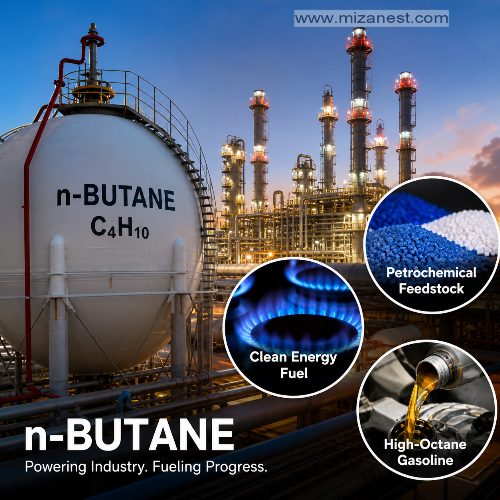
Normal Butane, commonly known as n-Butane, is one of the most important light hydrocarbons within the paraffin family, playing a critical role across refinery operations, petrochemical value chains, and downstream energy industries.
Beyond its traditional role as a fuel component, n-Butane is widely recognized as a strategic petrochemical feedstock used in olefin production and various base chemical manufacturing processes.
This article provides a detailed industrial analysis based on real operational datasheet parameters, making it suitable for direct publication on professional energy or petrochemical websites.
Scientific Introduction to Normal Butane
Normal Butane (C₄H₁₀) is a linear alkane produced through several industrial processes:
✅ Natural Gas Processing
✅ NGL Recovery Units
✅ Crude Oil Refining Operations
✅ Refinery LPG Recovery Systems
Unlike isobutane, n-Butane possesses a straight-chain molecular structure, which significantly influences its thermodynamic behavior, boiling characteristics, and petrochemical conversion performance.
Key characteristics valued by energy and petrochemical specialists include:
✔ Highly stable feedstock for Steam Cracking
✔ High conv
Offer dareersion efficiency to olefins
✔ Low sulfur impurities extending catalyst lifetime
Complete Interpretation of the Normal Butane Datasheet
The analyzed datasheet corresponds to production from Bidboland Persian Gulf Gas Refinery, one of the major LPG and C4 suppliers in the region.
Each parameter is interpreted below using refinery engineering standards.
Hydrocarbon Composition Analysis
Parameter Value Technical Interpretation
C2 Max 0.08 mol% Minimal ethane indicates efficient fractionation
C3 Max 2 mol% Low propane improves vapor pressure control
C4 Min 97.5 mol% Very high purity suitable for petrochemical feedstock
C5+ Max 0.82 mol% Low heavy hydrocarbons reduce coke formation
Engineering Evaluation
✅ C4 purity above 97.5% classifies the product as Petrochemical Grade.
✅ Low C5+ content minimizes fouling risks in cracking furnaces.
✅ The specification fully meets olefin plant feedstock requirements.
Quality and Safety Specifications
Parameter Value Industrial Significance
Copper Corrosion Max No.1 Non-corrosive to equipment
Hydrogen Sulfide Nil Suitable for export and petrochemical use
Total Organic Sulfur 30 ppm Protects catalysts
Water Content Max 10 ppm Prevents hydrate formation and corrosion
Vapor Pressure 4.8 Barg Stable storage and handling behavior
IBP (95% Evap.) 2.22°C Uniform vaporization performance
Operational Interpretation
✔ Absence of H₂S classifies the product as Sweet Gas.
✔ Extremely low moisture eliminates hydrate blockage risks.
✔ Controlled vapor pressure enhances LPG marine transportation safety.
Major Industrial Applications of Normal Butane
Olefin Production — The Primary Global Application
The true economic value of n-Butane is realized in olefin petrochemical production.
Steam Cracking Process
Inside steam cracking furnaces:
n-Butane → Ethylene + Propylene + Butadiene + Hydrogen
Produced derivatives include:
✅ Ethylene → Polyethylene, Ethylene Glycol
✅ Propylene → Polypropylene, Acrylic derivatives
✅ Butadiene → Synthetic rubber manufacturing
✅ Hydrogen → Hydrotreating refinery units
Why n-Butane is an Attractive Feedstock
✔ High olefin yield
✔ Lower energy consumption compared to naphtha
✔ Reduced coke formation
✔ Operational flexibility in modern crackers
For this reason, many advanced steam crackers in the Middle East and Asia partially rely on C4 feedstocks.
Butadiene Production and Rubber Industry
Normal Butane is converted first to butenes and subsequently to butadiene, supporting:
✔ Automotive tire production
✔ Industrial rubber applications
✔ ABS and SBR polymer manufacturing
Growing global demand for synthetic rubber directly strengthens the n-Butane market.
Isomerization and Isobutane Production
n-Butane → Isobutane
Applications include:
✅ MTBE production
✅ Gasoline octane enhancement
✅ Refinery alkylation feedstock
High-Octane Gasoline Production
Within Alkylation Units:
Isobutane + Olefins → Alkylate Gasoline
Results:
✔ Cleaner gasoline blending component
✔ Low aromatic content
✔ Compliance with Euro fuel standards
Industrial Fuel and LPG Applications
Although petrochemical use generates higher value, fuel applications remain significant:
✔ Export LPG blending
✔ Industrial heating fuel
✔ Camping fuel systems
✔ Lighters and aerosol propellants
Specialized Industrial Uses
✅ Polyurethane foam blowing agent
✅ Environmentally friendly refrigerant alternatives
✅ Solvent extraction processes
✅ Feedstock for Maleic Anhydride production
Economic Advantages of Normal Butane
From a global energy market perspective:
✔ Strategic bridge between refining and petrochemicals
✔ Flexible switching between fuel and feedstock markets
✔ Higher added value compared with conventional LPG
✔ Increasing demand across Asian petrochemical hubs
Many energy analysts consider n-Butane one of the most strategic C4 molecules in international hydrocarbon trade.
Technical Conclusion
Based on the evaluated datasheet, Normal Butane produced at Bidboland Persian Gulf Gas Refinery demonstrates:
✅ High petrochemical-grade purity
✅ Extremely low sulfur and moisture content
✅ Non-corrosive operational characteristics
✅ Ideal suitability for steam cracking and olefin production
✅ Strong compatibility with export and advanced industrial applications
Therefore, this grade holds a premium position both in fuel markets and across petrochemical value chains including olefins, butadiene, and high-octane gasoline production.
Reviews
There are no reviews yet.