



Description
🌟 Comprehensive Introduction to Nouri and Buali Petrochemicals Raffinate (Nouri and Buali Raffinate)
Presented by Alkimia, the official supplier of petrochemical products from Iran
🔍 What is Raffinate and Why is it Important?
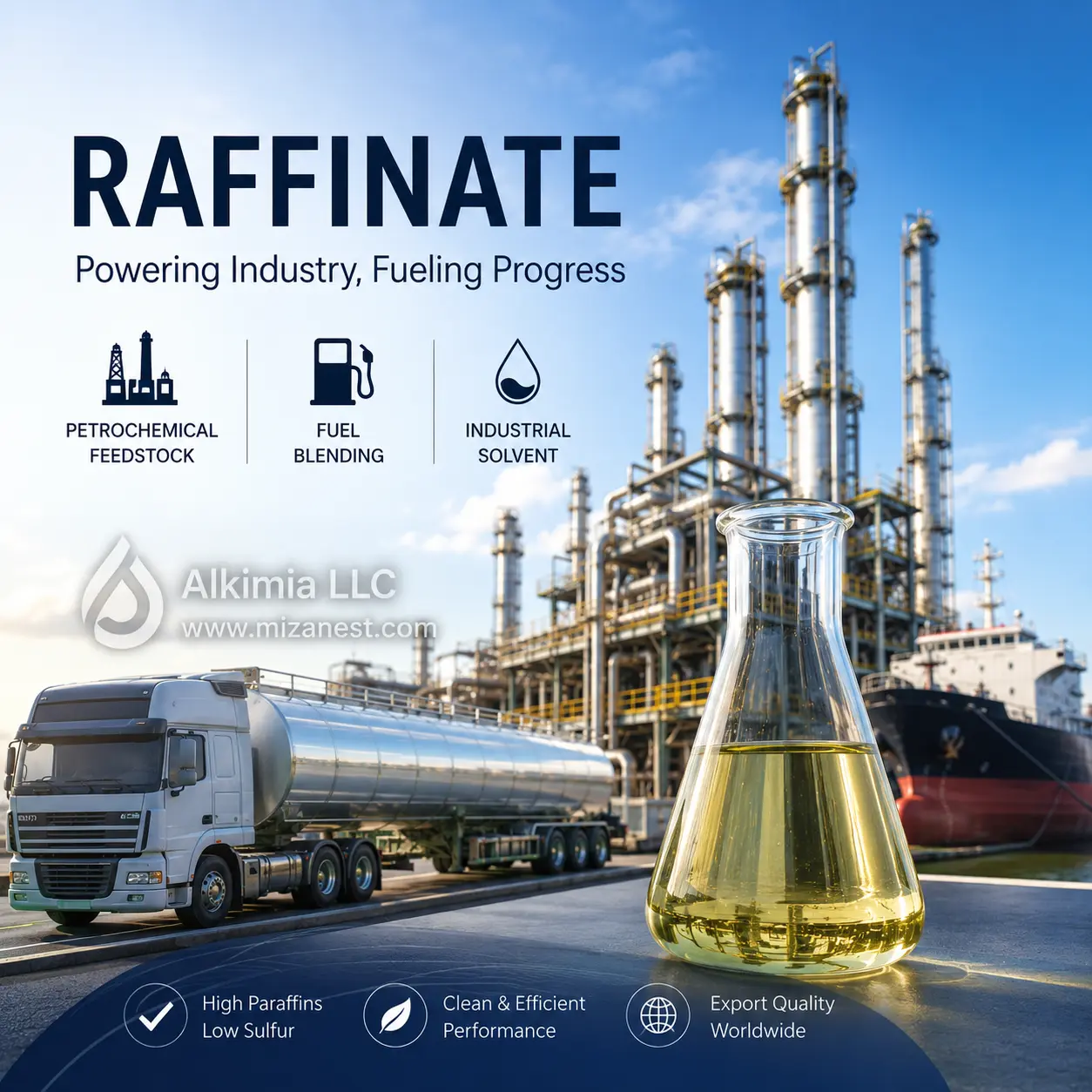
Raffinate is a light hydrocarbon fraction derived from refining streams rich in aromatic compounds. After the removal of aromatics such as benzene, toluene, and xylenes, the remaining by-product—raffinate—retains high economic and industrial value.
Depending on its composition, raffinate can contain a high percentage of paraffins (up to 92%), a specific amount of naphthenics, and a small percentage of olefins and aromatics. This unique composition makes raffinate a widely used material in the fuel and petrochemical industries, as well as in gasoline blending formulations.
📊 Technical Specifications of Nouri Petrochemical Raffinate (Based on Latest Analysis)
| No | Typical Test | Unit | Specification | Test Method |
|---|---|---|---|---|
| 1 | RVP | psia | Max 9.5 | ASTM D323 & ASTM D5191 |
| 2 | IBP | °C | 32–49 | ASTM D86 |
| 3 | 10% Distillation | °C | 50–59 | ASTM D86 |
| 4 | 50% Distillation | °C | 60–80 | ASTM D86 |
| 5 | 90% Distillation | °C | 80–100 | ASTM D86 |
| 6 | FBP (Final Boiling Point) | °C | 100–125 | ASTM D86 |
| 7 | Total Recovery | % | Min 97 | ASTM D86 |
| 8 | Paraffins | Wt% | Max 92 | IFP 9302 |
| 9 | Olefins | Wt% | Max 5 | IFP 9302 |
| 10 | Naphthenics | Wt% | 4.5–20 | IFP 9302 |
| 11 | Aromatics | Wt% | Max 7 | IFP 9302 |
| 12 | Density @15.6°C | g/cm³ | 0.65–0.70 | ASTM D4052 |
| 13 | Total Sulfur | ppm | Max 5 | ASTM D5453 & ASTM D7039 |
| 14 | Color (ASTM) | – | Max 15 | ASTM D1209 |
| 15 | RON (Research Octane No.) | – | <75 | ASTM D2699 |
⚙️ Technical Interpretation of Key Properties
- High Reid Vapor Pressure (RVP) indicates high volatility, which is important for gasoline blending.
- A wide boiling point range (32°C to 125°C) allows multipurpose use as feedstock or fuel.
- Low density improves performance as a light fuel.
- Extremely low sulfur content (less than 5 ppm) meets global environmental standards.
- n octane number below 75 limits its use in premium fuels but makes it suitable for blending with octane boosters.
Bouali Sina Petrochemical Raffinate — Technical Overview and Product Analysis
At Bouali Sina Petrochemical Company, raffinate is generated as a high-value light hydrocarbon product widely used in fuel blending and petrochemical downstream applications.
In simple technical terms, raffinate represents the non-aromatic fraction remaining after removal of Benzene, Toluene, and Xylenes (BTX). Due to its high paraffinic composition and very low sulfur level, it is considered a strategic blending and processing feedstock in modern refineries.
Complete Raffinate Specification Table
Parameter Specification Unit Colour (Saybolt) +18 Min – Density 650 – 740 kg/m³ Initial Boiling Point 30 Min °C Final Boiling Point 130 Max °C Lead 5 Max wt ppb Olefins Content 14 Max wt% Paraffins Content 70 Min wt% RVP (Reid Vapor Pressure) 11 Max psi Sulfur 1.5 Max wt ppm (Data based on official product analysis sheet)
Detailed Technical Interpretation of Raffinate Analysis
✅ Saybolt Color (+18 Minimum)
The Saybolt color index measures visual purity and hydrocarbon cleanliness.
A value of +18 indicates:
✔ Excellent refining quality
✔ Minimal heavy aromatic contamination
✔ High suitability for gasoline blending operationsHigher Saybolt values generally reflect superior processing control in aromatics units.
✅ Density (650–740 kg/m³)
This density range classifies the product as a light hydrocarbon stream, similar to Light Naphtha fractions.
Engineering advantages include:
✔ Improved combustion efficiency
✔ Enhanced octane blending capability
✔ Optimized vaporization behavior in fuel systems✅ Boiling Range (30–130°C)
The distillation range is one of the most critical performance indicators.
This boiling window confirms:
✔ Compatibility with gasoline pool blending
✔ Suitability as petrochemical cracking feedstock
✔ Excellent cold-start fuel behaviorLow initial boiling point contributes to rapid ignition characteristics.
✅ Lead Content (≤5 ppb)
The extremely low lead content demonstrates:
✔ Compliance with modern environmental regulations
✔ Export suitability for international markets
✔ Safe usage in catalytic refining processesLead-free streams are essential for protecting downstream catalysts.
✅ Olefins Content (≤14 wt%)
Olefins are chemically reactive hydrocarbons.
Controlled olefin concentration provides:
✔ Better storage stability
✔ Reduced gum formation
✔ Improved oxidation resistanceThis balance is highly valued in refinery blending strategies.
✅ Paraffins Content (≥70 wt%)
High paraffin concentration is the most significant strength of Bouali Sina raffinate.
Technical benefits include:
✔ Excellent gasoline blending component
✔ Ideal feed for isomerization units
✔ High-quality alkylation feedstock potential
✔ Stable combustion characteristicsFrom a refinery engineering perspective, high paraffinic composition significantly increases commercial value.
✅ Reid Vapor Pressure — RVP (≤11 psi)
RVP determines fuel volatility behavior.
Controlled vapor pressure ensures:
✔ Safe storage and transportation
✔ Reduced evaporative losses
✔ Compliance with gasoline volatility standards✅ Ultra-Low Sulfur Content (≤1.5 ppm)
The sulfur level is exceptionally low compared to many regional raffinate streams.
Key advantages:
✔ Reduced SOx emissions
✔ Catalyst protection in downstream units
✔ Compliance with modern clean-fuel standards
✔ Premium export acceptanceLow sulfur content is widely considered a major competitive advantage.
Industrial Applications of Bouali Sina Raffinate
✅ Gasoline blending component
✅ Isomerization unit feedstock
✅ Steam cracker feed
✅ Petrochemical intermediate production
✅ Light industrial solvent applications
✅ Regional and international fuel export marketsProfessional Technical Conclusion
Bouali Sina Petrochemical raffinate demonstrates a well-balanced hydrocarbon profile combining:
✔ High paraffin concentration
✔ Ultra-low sulfur content
✔ Controlled olefin level
✔ Ideal gasoline boiling rangeFrom an expert refining viewpoint, the combination of high paraffins + very low sulfur + stable volatility represents exactly the characteristics required for modern refinery optimization and petrochemical integration. This positions the product among competitively strong raffinate streams available in the regional export market.
🛠️ Industrial Applications of Raffinate
- Feedstock for Petrochemical Units
With its controlled composition, raffinate is an excellent feed for steam cracking and isomerization units. Producers of ethylene, propylene, butadiene, and other light derivatives utilize raffinate to enhance efficiency. - Light Fuel or Gasoline Blending
Due to its high vapor pressure and appropriate boiling range, it can be used in light gasoline formulations or blended with refined diesel. - Industrial Solvent
In the paint, thinner, adhesive, and lubricant industries, raffinate is used as a high-volatility solvent with linear dissolving behavior. - Export to Consumer Markets
Thanks to its competitive price, standard technical profile, and easy transportability, raffinate is a popular choice among petrochemical importers across Asia, Europe, and Africa.
📦 Carrying and Delivery
Raffinate is shipped in bulk using insulated tankers, ISO tanks, or specialized drums for volatile fuels. All logistics follow IMO / ADR / RID regulations and international safety standards.
🎯 Advantages of Purchasing Raffinate from Alkimia
- Direct supply from Nouri Petrochemical with verified analysis
- Fast delivery in large volumes
- Competitive pricing with export consultancy
- Ongoing customer service and support
📞 For Price Inquiries and Official Analysis Reports:
Get in touch with us
📧 Email: sales@alkimia.am
📞 Tel: +98 (51) 33408210
📍 Address: Mojallal Commercial Center, Mashhad, Iran
Reviews
There are no reviews yet.