



Description
LLDPE 22501AA/22501KJ – Complete Guide to Features, Processing, Applications and Technical Performance
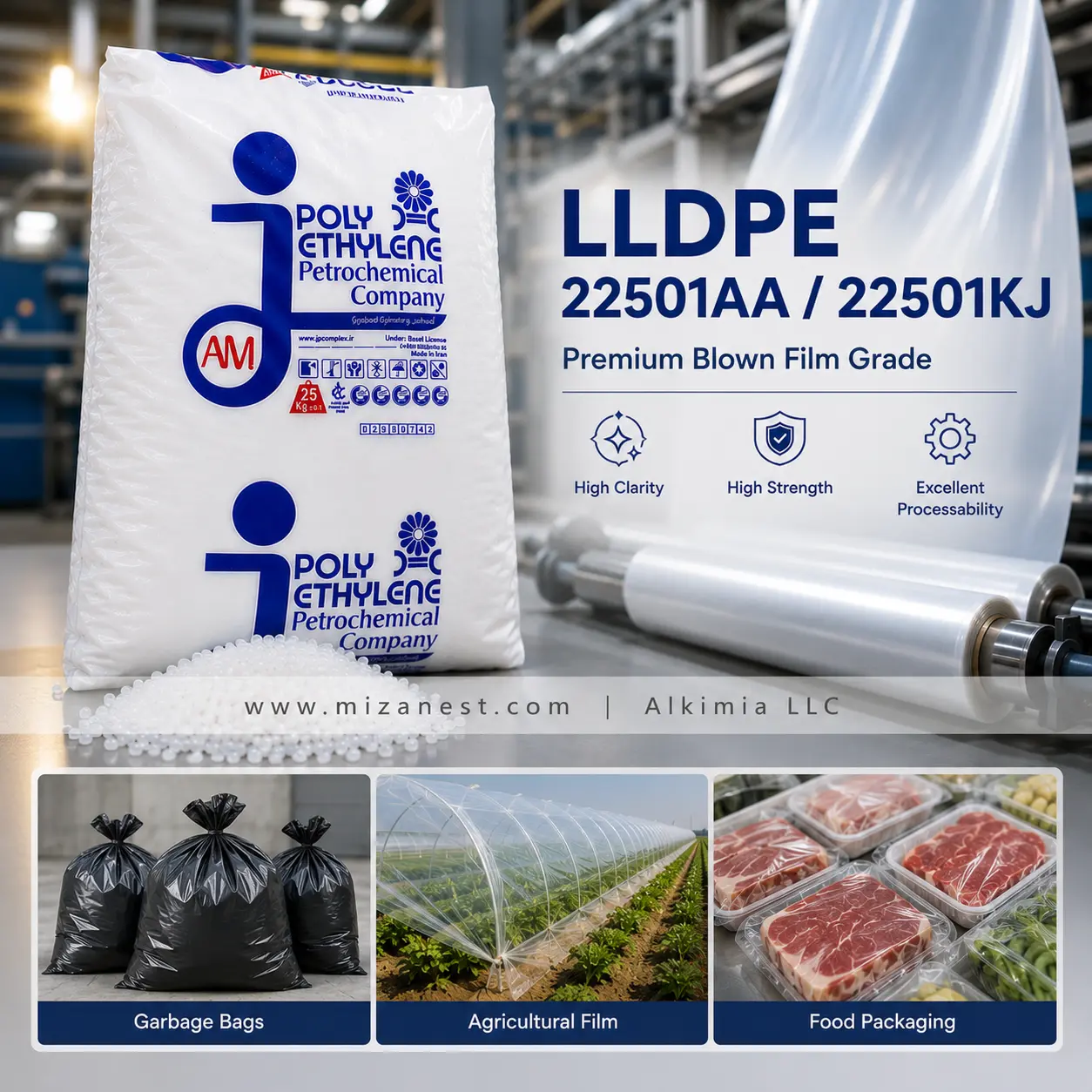
Linear Low Density Polyethylene (LLDPE) is one of the most widely used polymers in the packaging industry because it combines excellent mechanical strength, flexibility, sealability, and cost efficiency. Among the film grades produced in Iran, LLDPE 22501AA/22501KJ manufactured by Jam Petrochemical Company has become a popular choice for converters producing shopping bags, industrial liners, agricultural films, shrink films, and multilayer packaging.
Unlike many product pages that simply repeat a technical data sheet, this guide explains what every important property actually means in production. Whether you are a purchasing manager looking for a reliable supplier or a production engineer selecting the proper resin for a film extrusion line, understanding these characteristics helps reduce production costs while improving product quality.
This article provides a practical explanation of the resin’s performance, processing behavior, advantages, limitations, and industrial applications.
What is LLDPE 22501AA/22501KJ?
LLDPE 22501AA and LLDPE 22501KJ are linear low density polyethylene film grades designed primarily for blown film extrusion. They offer an excellent balance between strength, flexibility, processability, and optical properties, making them suitable for both general-purpose and demanding packaging applications.
These grades are manufactured using modern gas-phase polymerization technology, producing a resin with uniform molecular structure and consistent quality from batch to batch.
Although both grades share nearly identical mechanical properties, they are intended for different production requirements.
LLDPE 22501AA
The AA grade is a standard natural resin without additional processing additives. It is commonly selected by manufacturers who prefer adding their own masterbatches, slip agents, anti-block additives, pigments, or other processing modifiers during production.
Its flexibility allows converters to customize the final formulation according to the specific requirements of their customers.
LLDPE 22501KJ
The KJ grade contains carefully controlled slip and anti-block additives that improve processing performance immediately after extrusion.
These additives help:
- Reduce film-to-film adhesion
- Improve film opening
- Enhance winding performance
- Reduce friction during bag production
- Increase production speed
- Improve handling on automatic packaging machines
For manufacturers producing high volumes of packaging film, these improvements often translate into lower downtime and higher productivity.
About Jam Petrochemical Company
Jam Petrochemical Company is one of the largest polymer producers in the Middle East and one of Iran’s major exporters of polyethylene products.
The company operates modern production units capable of manufacturing numerous grades of:
- HDPE
- LDPE
- LLDPE
Its products are exported to Asia, Europe, CIS countries, the Middle East, and Africa.
Because of consistent quality control, reliable production capacity, and competitive pricing, Jam Petrochemical grades have become well recognized among international polymer traders and packaging manufacturers.
Many film producers choose Jam products because they offer stable processing characteristics across different production batches, reducing unnecessary machine adjustments.
Why Was LLDPE 22501 Developed?
Every polymer grade is designed to solve specific manufacturing challenges.
Film producers generally expect a resin to provide several characteristics simultaneously:
- High mechanical strength
- Excellent flexibility
- Stable bubble formation
- Good optical appearance
- Easy processing
- Low production cost
- High output rate
Achieving all of these characteristics together is not simple.
If a polymer is too soft, film strength decreases.
If it is too rigid, flexibility suffers.
If melt strength is insufficient, bubble stability becomes difficult.
If additives are excessive, optical properties may deteriorate.
LLDPE 22501AA/22501KJ was developed to achieve a balanced combination of these requirements, making it suitable for a wide variety of film applications rather than only one specialized product.
This balance explains why it has become one of the most commonly selected LLDPE film grades in regional markets.
Understanding the Technical Data Sheet
Many buyers compare only numerical values when selecting polymer grades.
However, understanding what those values mean is far more important than simply reading the numbers.
Density
Typical Density
0.923–0.924 g/cm³
Density is one of the primary characteristics that determines how a polyethylene material behaves.
A density in this range indicates that the polymer belongs to the LLDPE family rather than LDPE or HDPE.
This density provides several practical benefits.
Improved Flexibility
Lower density allows polymer chains to move more freely, producing softer and more flexible films.
This flexibility is particularly valuable for shopping bags, industrial liners, and stretchable packaging.
Better Impact Resistance
Flexible molecular structures absorb impact energy more efficiently.
This reduces the likelihood of sudden tearing during transportation or handling.
Excellent Heat Sealing
Films produced from this density range generally exhibit reliable heat sealing performance while maintaining sufficient mechanical strength.
Melt Flow Index (MFI)
Typical Value
0.85–1.05 g/10 min
Melt Flow Index measures how easily molten polymer flows during extrusion.
Many buyers mistakenly assume that a higher MFI automatically indicates a better material.
In reality, each application requires a specific melt flow range.
For blown film production, an MFI around 1 is considered an excellent balance.
Why not a higher MFI?
Higher MFI materials flow more easily but generally produce lower melt strength.
Lower melt strength can lead to unstable bubbles during blown film extrusion.
Why not a lower MFI?
Very low MFI materials provide excellent strength but become harder to process.
They require higher extrusion pressure, increased energy consumption, and sometimes lower production speeds.
The selected MFI range of LLDPE 22501AA/KJ provides stable extrusion while maintaining strong film performance.
Tensile Strength
Typical TD Strength
Up to 31 MPa
Tensile strength measures how much force a film can withstand before breaking.
For packaging manufacturers, this directly influences product durability.
Higher tensile strength contributes to:
- Stronger shopping bags
- Better industrial liners
- Improved pallet wrapping
- Reduced transportation damage
A strong film allows manufacturers to reduce film thickness without significantly sacrificing performance, helping lower raw material consumption.
Elongation at Break
Typical Value
Up to 780%
One of the most impressive properties of this grade is its exceptional elongation.
An elongation of nearly eight times the original length indicates remarkable flexibility.
Instead of tearing immediately when stretched, the material absorbs mechanical stress gradually.
This characteristic improves:
- Puncture resistance
- Tear resistance
- Load carrying capacity
- Handling safety
For flexible packaging, high elongation often represents one of the most valuable mechanical properties.
Haze
Typical Value
Approximately 48%
Haze measures the amount of light scattered while passing through the film.
Lower haze generally produces clearer packaging.
Higher haze creates a more opaque appearance.
The haze level of LLDPE 22501 provides a practical balance suitable for numerous commercial packaging applications where moderate transparency is preferred.
For applications demanding crystal-clear appearance, manufacturers often optimize formulations by blending with other compatible polyethylene grades.
Gloss
Typical Value
Approximately 34%
Gloss determines how shiny the film surface appears.
A glossy film creates a more attractive product presentation.
This becomes especially important in retail packaging because consumers often associate glossy packaging with higher product quality.
The gloss characteristics of this grade provide attractive appearance while maintaining excellent mechanical performance.
Film Thickness Capability
Recommended Range
15–150 microns
One of the strengths of LLDPE 22501AA/KJ is its wide processing window.
It can successfully produce both lightweight packaging films and thicker industrial products.
Thin films help reduce raw material consumption and shipping costs.
Thicker films provide increased durability for demanding industrial applications.
This flexibility allows converters to serve multiple market segments using a single polymer grade.
Processing Guide for LLDPE 22501AA/22501KJ
Choosing the right resin is only one part of producing high-quality polyethylene film. Even the best polymer grade cannot deliver consistent performance if processing conditions are not properly controlled.
LLDPE 22501AA/22501KJ has been developed to provide a stable processing window, making it suitable for both medium- and high-speed blown film extrusion lines. Its balanced melt strength allows converters to achieve stable bubble formation while maintaining excellent mechanical properties in the final film.
Although exact machine settings vary depending on the extrusion line, die design, ambient conditions, and the thickness of the film being produced, the following recommendations provide an excellent starting point for most production environments.
Recommended Processing Temperature
One of the advantages of this grade is its relatively wide processing temperature range.
Typical melt temperatures fall between 190°C and 230°C, allowing manufacturers to optimize production according to film thickness and machine capability.
Operating at excessively low temperatures may result in incomplete melting, poor surface quality, unstable pressure, and visible unmelted particles.
Conversely, unnecessarily high temperatures increase energy consumption and may accelerate polymer degradation, leading to discoloration, unpleasant odor, reduced mechanical strength, and gel formation.
Maintaining a stable melt temperature throughout the extrusion process generally produces the best combination of appearance, strength, and processing efficiency.
Typical Temperature Profile
While every extrusion line has its own characteristics, many converters use a gradual temperature increase from the feed zone to the die.
A typical temperature profile may resemble the following:
| Extruder Zone | Typical Temperature |
|---|---|
| Feed Zone | 170–180°C |
| Compression Zone | 180–195°C |
| Metering Zone | 195–210°C |
| Adapter | 205–220°C |
| Die | 210–225°C |
Rather than focusing on achieving the highest possible temperature, operators should aim for a stable melt with consistent pressure and smooth flow through the die.
Blown Film Extrusion Performance
LLDPE 22501AA/22501KJ has been specifically designed for blown film production.
During blown film extrusion, molten polymer exits the circular die and is inflated with air to form a stable bubble before cooling and collapsing into flat film.
Successful production depends on maintaining bubble stability throughout the process.
The balanced molecular structure of this resin contributes to:
- Stable bubble formation
- Uniform film thickness
- Good melt strength
- Smooth extrusion
- Consistent winding performance
These characteristics are particularly valuable during long production runs where process stability directly influences productivity.
Screw Design Considerations
Most conventional polyethylene extrusion screws perform well with this grade.
General-purpose screws with a compression ratio around 2.5:1 to 3:1 usually provide excellent melting performance.
A properly designed screw should achieve:
- Uniform melting
- Stable pressure
- Low melt temperature variation
- Minimal polymer degradation
Poor screw design often causes greater production problems than the polymer itself.
Blow-Up Ratio (BUR)
The Blow-Up Ratio significantly influences film properties.
Increasing the BUR generally improves transverse orientation, while lower values tend to enhance machine-direction properties.
For many commercial packaging applications, a moderate Blow-Up Ratio provides the most balanced mechanical performance.
Selecting the appropriate BUR depends on:
- Required film strength
- Film thickness
- Application
- Machine capability
Frost Line Height
The Frost Line represents the location where molten polymer solidifies into film.
Maintaining a stable Frost Line improves:
- Film thickness uniformity
- Bubble stability
- Optical appearance
- Mechanical consistency
Sudden movement of the Frost Line often indicates unstable processing conditions.
Possible causes include:
- Temperature fluctuations
- Cooling instability
- Air ring imbalance
- Inconsistent extrusion output
Cooling Efficiency
Cooling has a direct influence on film quality.
Efficient cooling improves:
- Production speed
- Gloss
- Film stability
- Thickness consistency
Insufficient cooling may produce:
- Wrinkles
- Bubble oscillation
- Variable thickness
- Poor winding quality
Maintaining clean air rings and balanced airflow helps maximize production efficiency.
Common Processing Problems and Solutions
Even experienced converters occasionally encounter processing issues.
Understanding the relationship between resin properties and machine settings allows many problems to be solved quickly without unnecessary production interruptions.
Bubble Instability
One of the most common issues in blown film production is an unstable bubble.
An unstable bubble may oscillate, collapse, or continuously change diameter, making it difficult to maintain uniform film thickness.
Common causes include:
- Incorrect temperature profile
- Inadequate cooling
- Excessive extrusion speed
- Air ring imbalance
- Worn die components
Recommended solutions include:
- Stabilize melt temperature.
- Inspect the cooling system.
- Reduce excessive output rates.
- Check air ring alignment.
- Ensure clean die lips.
Blocking
Blocking occurs when two film layers adhere to each other after winding.
This problem slows bag production and increases waste.
The KJ grade includes anti-block additives specifically designed to minimize this issue.
Additional preventive measures include:
- Improve film cooling.
- Avoid excessive winding tension.
- Store rolls under appropriate temperatures.
- Maintain clean processing equipment.
Fish Eyes
Fish Eyes appear as small transparent or hard particles within the film.
These defects reduce optical quality and may weaken the finished product.
Typical causes include:
- Contaminated raw material
- Polymer degradation
- Unmelted pellets
- Dirty extrusion equipment
Preventive maintenance and proper material handling significantly reduce Fish Eye formation.
Gel Formation
Gels are localized regions of degraded or crosslinked polymer.
Unlike Fish Eyes, gels often originate from thermal degradation inside the extrusion system.
Possible causes include:
- Excessive melt temperature
- Long residence time
- Dead spots inside the extruder
- Oxidized polymer deposits
Regular cleaning of the screw, adapter, and die helps prevent gel formation.
Thickness Variation
Non-uniform film thickness increases material consumption and reduces product quality.
Typical causes include:
- Bubble instability
- Die contamination
- Uneven cooling
- Variable screw speed
Maintaining stable processing conditions generally minimizes thickness variation.
Poor Optical Appearance
If the finished film appears cloudy, dull, or uneven, several factors should be evaluated.
These include:
- Cooling efficiency
- Processing temperature
- Resin contamination
- Surface cleanliness
- Incorrect formulation
Improving these parameters usually enhances both gloss and transparency.
Wrinkles During Winding
Wrinkles not only reduce product appearance but also create difficulties during printing and bag conversion.
Possible reasons include:
- Misaligned collapsing frame
- Uneven winding tension
- Bubble instability
- Roller contamination
Routine inspection of the winding system helps maintain consistent roll quality.
Practical Tips for Higher Production Efficiency
Experienced converters know that maximizing output does not simply mean increasing screw speed.
Higher productivity comes from maintaining stable processing conditions while minimizing waste.
The following practices often improve overall plant performance:
- Store resin in a dry, clean environment before processing.
- Keep the extrusion system free of degraded polymer.
- Monitor melt pressure continuously.
- Inspect die lips regularly for contamination.
- Use consistent raw material batches whenever possible.
- Avoid unnecessary temperature fluctuations during production.
- Allow the extrusion line to reach thermal equilibrium before increasing output.
- Record processing parameters for successful production runs to simplify future setup.
Consistent production conditions generally result in lower scrap rates, improved product quality, reduced maintenance requirements, and higher profitability over time.
Industrial Applications of LLDPE 22501AA/22501KJ
One of the main reasons for the commercial success of LLDPE 22501AA/22501KJ is its versatility. Instead of being limited to a single application, this resin performs well across a wide range of packaging and industrial film products.
Its balanced combination of strength, flexibility, processability, and optical properties enables manufacturers to produce various films using the same polymer grade, reducing inventory complexity and improving production efficiency.
Shopping Bags
Shopping bags remain one of the largest applications for LLDPE film worldwide.
Manufacturers require a material that can produce lightweight bags without sacrificing strength.
LLDPE 22501AA/22501KJ provides:
- Excellent puncture resistance
- High tear strength
- Good flexibility
- Reliable sealing performance
- Smooth processing on high-speed production lines
Because of its high elongation at break, shopping bags made from this grade are less likely to fail suddenly when carrying heavy loads.
Garbage Bags
Garbage bags are exposed to concentrated loads, sharp objects, and repeated stretching.
A suitable polymer should combine toughness with flexibility.
The balanced mechanical properties of LLDPE 22501AA/22501KJ help manufacturers produce bags that resist tearing while remaining economical.
For heavy-duty garbage bags, this grade is often blended with other polyethylene materials to further optimize strength and processing performance.
Agricultural Films
Agricultural films must withstand demanding environmental conditions.
They are continuously exposed to:
- Sunlight
- Wind
- Moisture
- Temperature fluctuations
Depending on the formulation, LLDPE 22501 can be incorporated into agricultural film structures where flexibility and mechanical durability are important.
For long-term outdoor exposure, converters typically combine the resin with UV stabilizers and other performance-enhancing additives.
Industrial Packaging Films
Industrial packaging frequently involves wrapping products with irregular shapes and significant weight.
The packaging film must absorb impact without breaking.
The excellent elongation and tensile properties of this grade make it suitable for many industrial packaging applications, including:
- Protective liners
- Industrial sacks
- Equipment covers
- Pallet protection films
Multilayer Packaging
Modern packaging increasingly relies on multilayer film technology.
Instead of using a single material, several polymer layers are combined to achieve specific performance characteristics.
LLDPE 22501AA/22501KJ is often incorporated into multilayer structures because it provides:
- Excellent sealability
- Good mechanical strength
- Strong puncture resistance
- Reliable flexibility
When combined with LDPE, HDPE, or barrier materials, manufacturers can produce packaging that meets demanding industrial and food packaging requirements.
Printed Packaging Film
Printing quality depends heavily on film surface characteristics.
A smooth and consistent surface improves:
- Ink adhesion
- Color uniformity
- Print clarity
- Registration accuracy
After appropriate surface treatment, films produced from this grade can achieve attractive printing performance for retail packaging.
Advantages of LLDPE 22501AA/22501KJ
Compared with many conventional polyethylene film grades, this material offers several practical benefits.
Excellent Mechanical Balance
The resin combines strength and flexibility without requiring significant compromises.
Stable Processing
Its processing window allows manufacturers to maintain consistent production over long operating periods.
Good Optical Properties
Balanced haze and gloss provide attractive packaging appearance.
Wide Thickness Range
Suitable for both thin packaging films and thicker industrial applications.
Good Heat Sealing
Reliable sealing improves packaging integrity while reducing production defects.
Excellent Toughness
High puncture and tear resistance increase product durability.
High Productivity
Stable extrusion often enables higher production rates with reduced downtime.
Cost Efficiency
Lower scrap rates and efficient processing contribute to reduced manufacturing costs.
Limitations
No polymer grade is ideal for every application.
Understanding the limitations of LLDPE 22501AA/22501KJ helps manufacturers select the most appropriate material.
This grade may not be the best choice when:
- Extremely high rigidity is required.
- Exceptional optical clarity is the primary objective.
- Very high-temperature service conditions are expected.
- Specialized stretch film formulations are needed.
- Extremely high stiffness is more important than flexibility.
For these applications, alternative polyethylene grades or other polymer families may provide better overall performance.
Selecting the correct resin always depends on the specific requirements of the finished product.
Quality Control Before Purchasing
Purchasing polymer resin involves more than comparing prices.
Reliable buyers typically evaluate several quality indicators before placing large-volume orders.
Important checkpoints include:
Certificate of Analysis (COA)
Review the Certificate of Analysis to verify that the supplied batch meets published specifications.
Batch Consistency
Consistent quality from batch to batch minimizes production adjustments.
Packaging Quality
Damaged bags may allow contamination or moisture to enter during transportation.
Pellet Appearance
Pellets should be clean, uniform, and free from visible contamination.
Storage History
Improper storage may affect resin quality before processing.
Packaging and Storage
LLDPE 22501AA/22501KJ is commonly supplied in 25 kg bags suitable for manual handling and palletized transportation.
To preserve product quality:
- Store in a clean and dry warehouse.
- Protect from direct sunlight.
- Keep away from excessive heat sources.
- Avoid prolonged exposure to temperatures above 50°C.
- Rotate inventory according to the First-In, First-Out (FIFO) principle.
Under appropriate storage conditions, the material generally maintains its properties for up to 18 months, although earlier processing is recommended whenever practical.
Export Information
As one of Iran’s leading polyethylene products, LLDPE 22501AA/22501KJ is regularly exported to numerous international markets.
Typical export destinations include:
- Turkey
- Iraq
- Armenia
- Azerbaijan
- Pakistan
- India
- China
- CIS countries
- Middle Eastern markets
- African markets
The resin is commonly shipped in:
- 20-foot containers
- 40-foot containers
- Jumbo bag shipments
- Bulk export cargoes, depending on customer requirements
Professional exporters generally provide:
- Commercial Invoice
- Packing List
- Certificate of Origin
- Certificate of Analysis
- Bill of Lading (for sea shipments)
The exact documentation depends on the destination country and contractual requirements.
Frequently Asked Questions (FAQ)
What is LLDPE 22501AA mainly used for?
It is primarily used for blown film applications such as shopping bags, garbage bags, industrial packaging, agricultural films, and multilayer flexible packaging.
What is the difference between 22501AA and 22501KJ?
The KJ grade contains slip and anti-block additives that improve film handling and processing, while the AA grade is supplied without these additives, allowing manufacturers to customize formulations with their own masterbatches.
Is this grade suitable for multilayer film?
Yes. It is widely used in multilayer film structures because of its excellent sealability, flexibility, and mechanical strength.
Can it be blended with other polyethylene grades?
Yes. It is commonly blended with LDPE, HDPE, and other LLDPE grades to achieve specific processing or performance requirements.
Is it suitable for food packaging?
Depending on local regulations and the final formulation, this grade can be used in food packaging applications where the necessary compliance requirements are met.
What processing method is recommended?
Blown film extrusion is the primary processing method for this grade.
Conclusion
LLDPE 22501AA/22501KJ from Jam Petrochemical represents a well-balanced film-grade polyethylene designed for converters seeking reliable processing, strong mechanical performance, and cost-effective production.
Its combination of stable extrusion behavior, excellent toughness, good sealing characteristics, and broad application range makes it a dependable choice for manufacturers producing flexible packaging films.
Whether your business focuses on retail packaging, industrial liners, agricultural films, or multilayer structures, this grade provides the consistency and performance needed to improve production efficiency while maintaining high product quality.
By understanding not only the technical data sheet but also the practical implications of each material property, buyers and production engineers can make more informed purchasing decisions and achieve better long-term manufacturing results.
Reviews
There are no reviews yet.