


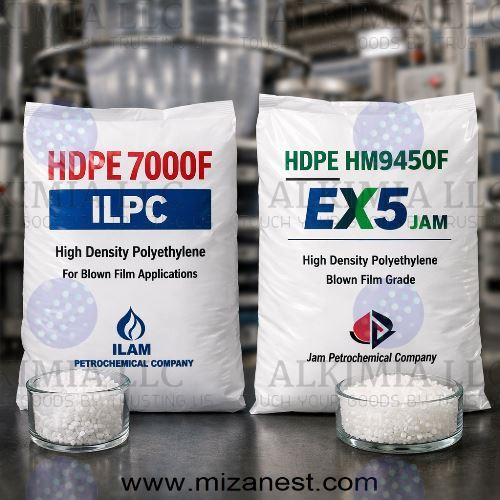
Best HDPE Grade for Blown Film
Technical and Engineering Comparison of HDPE 7000F and HDPE EX5 (HM9450F)
The Importance of Choosing the Right HDPE Grade for Blown Film
Selecting the best HDPE grade for blown film is not merely a commercial or price-based decision. This choice directly affects production line stability, final film quality, scrap rate, energy consumption, and even production speed. Both HDPE 7000F and HM9450F (EX5) are specifically designed for blown film applications, yet they differ fundamentally in polymer structure, rheological behavior, and targeted end-use. This article presents a documented technical comparison of these two grades.
Technical Overview of HDPE 7000F
HDPE 7000F is a product of Ilam Petrochemical Company. It is a high-molecular-weight copolymer HDPE with a broad molecular weight distribution. According to the official datasheet, this grade is engineered to provide a combination of high melt strength, excellent mechanical performance, and the ability to produce very thin films.
The density of HDPE 7000F is 0.952 g/cm³, indicating high stiffness and a more compact crystalline structure compared to many film grades. Its melt flow rate, measured at 190°C under a 5 kg load, is only 0.04 g/10 min. This extremely low value clearly reflects very high melt viscosity and significant molecular weight.
From a mechanical standpoint, HDPE 7000F delivers robust properties. Yield stress is approximately 27 MPa, tensile strength at break exceeds 24 MPa, and elongation at break is greater than 500%. In addition, an environmental stress crack resistance (ESCR) of over 600 hours according to ASTM D1693 indicates excellent durability under demanding service conditions.
Technical Overview of HDPE EX5 (HM9450F)
HM9450F, commercially known as HDPE EX5, is produced by Jam Petrochemical Company using the Hostalen process and slurry polymerization technology. This grade is a bimodal HDPE based on 1-butene comonomer, designed to balance strength, stiffness, and processability.
The density of HDPE EX5 ranges from 0.947 to 0.951 g/cm³, slightly lower than HDPE 7000F. This lower density contributes to greater flexibility in the final film. The melt flow rate at 190°C and 5 kg load is reported between 0.23 and 0.33 g/10 min, which indicates significantly higher flowability compared to 7000F.
EX5 also features a high FRR (Flow Rate Ratio), reflecting its bimodal molecular weight distribution and more stable behavior during blown film extrusion. This grade is supplied with built-in additives such as antioxidants, processing stabilizers, lubricants, and acid scavengers, all aimed at reducing process instability and improving production consistency.
Rheological Behavior and Processability Comparison
From a processing perspective, the key difference between these two grades lies in their melt behavior. HDPE 7000F, due to its extremely low MFR, provides exceptional melt strength, making it ideal for producing very thin films with high mechanical strength. However, this same characteristic makes the grade highly sensitive to variations in temperature, pressure, and screw speed. As a result, it requires a stable production line and precise process control.
In contrast, EX5, with its higher MFR and bimodal structure, offers easier start-up, faster bubble stabilization, and greater tolerance to processing fluctuations. This is a significant practical advantage, especially for older extrusion lines or systems with temperature variability.
Final Film Quality Comparison
Films produced with HDPE 7000F are typically stiffer, stronger, and drier in feel. This makes the grade well suited for heavy-duty shopping bags, thin industrial films, and multilayer liners. One of its major advantages is the ability to reduce film thickness without sacrificing mechanical strength, which translates into raw material savings.
On the other hand, films made from HDPE EX5 exhibit a more uniform surface, a paper-like appearance, and greater flexibility. These properties make EX5 a preferred choice for standard shopping bags, general packaging films, and consumer-oriented applications.
Recommended Processing Conditions
For HDPE 7000F, a melt temperature range of 200 to 215°C is recommended, with a frost line height approximately 6 to 8 times the die diameter. These parameters clearly indicate that this grade is intended for extrusion lines with precise and reliable process control.
For HDPE EX5, datasheet recommendations emphasize overall process stability and the benefits of built-in additives. Fewer strict constraints are placed on processing parameters, making this grade more suitable for continuous, interruption-free production.
Engineering Conclusion
If the objective is to produce very thin films with high mechanical strength and material downgauging, and the production line offers advanced process control, HDPE 7000F is the more rational choice. However, if production stability, scrap reduction, easier bubble control, and consistent film quality are the primary priorities, HM9450F (EX5) represents a safer and lower-risk option.
Neither grade is absolutely superior. True superiority lies in matching the material to the real conditions of the production line. This is precisely where professional material selection separates engineering judgment from market imitation.
